WhatsApp has become the go-to channel for patient communication, making chatbot selection an important decision for hospitals. Rule-based chatbots are ideal for handling simple, structured queries with lower cost and effort, while AI chatbots are better suited for complex, high-volume, and multilingual interactions. The right choice depends on a hospital’s size, patient volume, and workflow complexity. Many hospitals start with rule-based systems and transition to AI as their needs grow. Ultimately, the goal is to choose a solution that improves patient experience, reduces staff workload, and scales with the organization.
Key Takeaways:
- WhatsApp is already where patients prefer to interact with hospitals, so your chatbot choice directly impacts their experience.
- This isn’t about choosing advanced tech, it’s about what actually fits your workflows and daily operations.
- Rule-based chatbots work best for simple, repetitive tasks and are easy to set up and manage.
- But they struggle when conversations go off-script, often leading to patient frustration and more escalation.
- AI chatbots handle real, complex conversations better, including multilingual and context-driven queries.
- While they cost more upfront, AI chatbots reduce workload and scale efficiently as patient volume grows.
What Is a Rule-Based WhatsApp Chatbot?
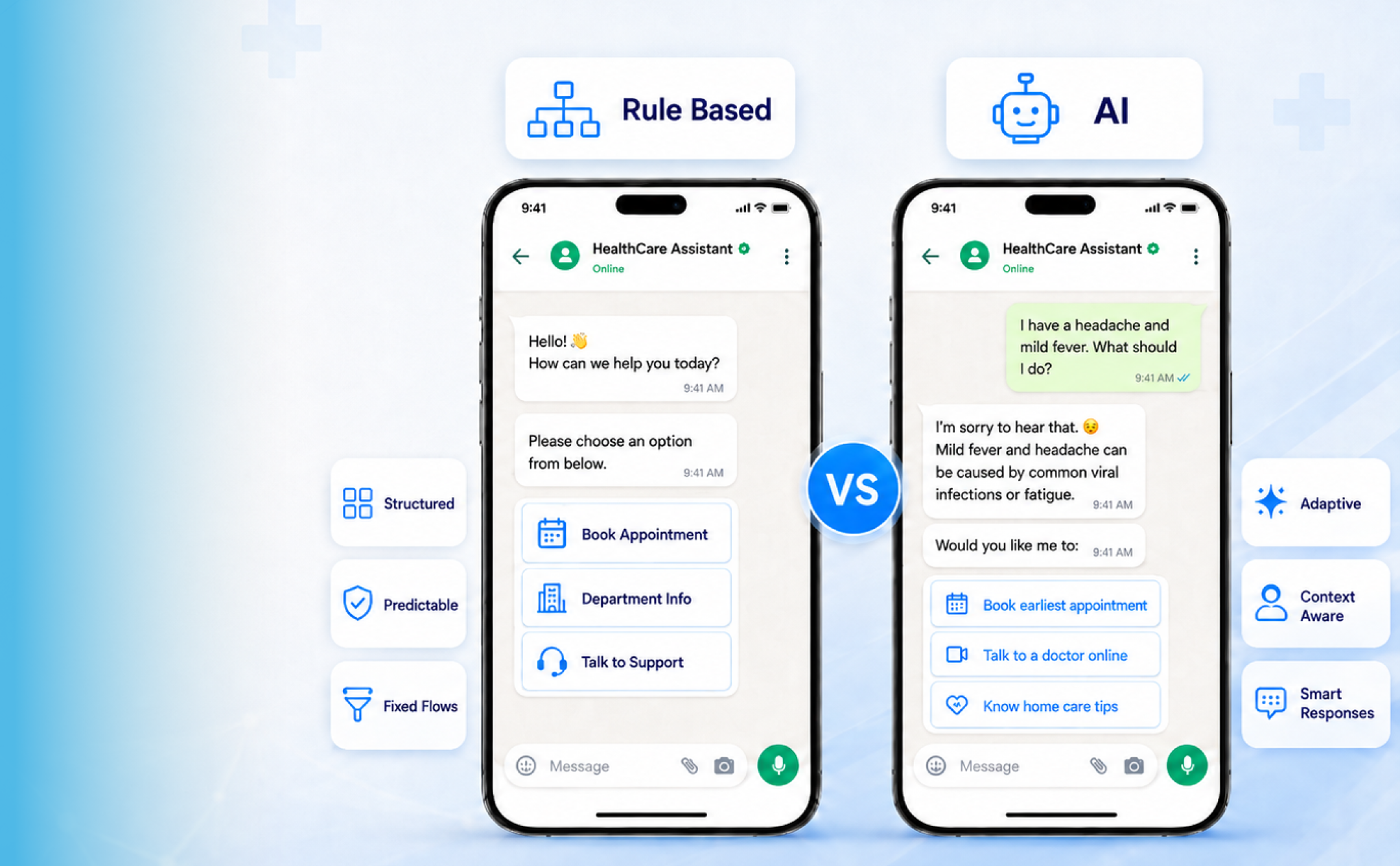
A rule-based chatbot operates on logic flows; think of it as a scripted conversation. The patient selects from a menu, the chatbot responds based on that selection, and the cycle continues. No interpretation, just structured, predictable paths.
These systems work through:
• Button-driven menus and decision trees
• Predefined responses mapped to specific inputs
• Keyword triggers that redirect conversations to relevant answers
Where Rule-Based WhatsApp Chatbots Work Best in Hospitals: Common Use Cases
Rule-based chatbots handle repetitive, structured tasks well. In a hospital context, this typically means:
• Appointment booking with a fixed set of departments or doctors
• Answering common FAQs on OPD timings, visiting hours, and test requirements
• Sharing doctor availability schedules
• Sending vaccination or follow-up reminders
• Directing patients to the right department
Advantages
• Highly predictable patients get consistent responses every time
• Lower implementation cost and shorter setup time
• Easier to manage from a compliance and audit standpoint
• Simple to train staff to update and maintain
Limitations
Here’s where rule-based systems hit a wall: the moment a patient steps outside the predefined script, the chatbot breaks down. A patient asking ‘I have chest pain and a fever, what should I do?’ will get a blank response or a confusing redirect. The chatbot doesn’t understand the question because it was never programmed for it.
• Cannot handle complex or unexpected questions
• Struggles with free-text inputs; patients don’t always type menu options
• Zero conversational flexibility, every variation needs a new rule
• Frequent escalations to human agents, defeating the purpose of automation
What Is an AI WhatsApp Chatbot for Hospitals?
AI WhatsApp chatbots are built on Natural Language Processing. They’re designed to understand what a patient means, not just what they type. Even if a patient writes in broken English, mixes languages, or unexpectedly asks a question, an AI chatbot can interpret intent and respond appropriately.
Core Capabilities of AI WhatsApp Chatbots for Healthcare
• NLP and intent recognition, understanding the ‘why’ behind a message
• Contextual conversation, remembering what was said earlier in the same chat
• Multilingual support handling patients who switch between languages mid-conversation
• Learning over time, improving based on real interactions
Common Use Cases of Rule-Based and WhatsApp Chatbots in Hospitals
AI chatbots can handle far more complex workflows:
• Symptom triaging, asking follow-up questions, and routing to the right specialist
• Smart appointment scheduling based on symptom type, urgency, and doctor availability
• Prescription and medication query assistance
• Patient follow-ups post-discharge, checking recovery, flagging concerns
• Handling insurance-related questions that require contextual understanding
Advantages
• Handles free-form conversations without breaking down
• Reduces human intervention significantly for routine and semi-complex queries
• Scales with patient volume without proportional increase in cost
• Provides a more natural, satisfying patient experience
Limitations
AI chatbots aren’t plug-and-play. They require investment in setup, training, and ongoing monitoring.
• Higher implementation complexity and cost
• Requires training on hospital-specific data for accuracy
• Needs regular monitoring to catch errors or hallucinations
• Integration with HIS/CRM systems adds technical overhead
| FEATURES | RULE BASED | AI CHATBOT |
| Query Handling | Fixed scripts only | Open-ended, flexible |
| Language Understanding | None (button-driven) | NLP + intent recognition |
| Personalization | Minimal | Context-aware |
| Scalability | Limited by script size | Highly scalable |
| Maintenance | Manual updates needed | Self-improves with training |
| Setup Cost | Lower | Higher upfront |
| Human Dependency | High | Lower |
| Integration Complexity | Simple | Moderate to High |
Which Chatbot Is Better for Small Hospitals?
Small hospitals and single-specialty clinics often have straightforward, predictable workflows. A patient visiting a dermatology clinic, for example, is likely calling for appointment booking, test results, or basic queries, all of which fall neatly into a rule-based script.
For hospitals with limited IT budgets, smaller support teams, and lower daily patient volumes, a rule-based chatbot is often the smarter starting point. It’s faster to deploy, easier to manage, and doesn’t require ongoing AI training or supervision.
The truth: if your chatbot handles 80% of queries through 10 predefined flows, you don’t need AI yet. Start with what works and scale up when the gaps become obvious.
Which Chatbot Is Better for Large Hospitals and Healthcare Chains?
Large hospitals, especially multi-specialty chains with patients across cities and demographics, face a different kind of challenge. When you’re handling thousands of WhatsApp queries daily across departments, in multiple languages, and across time zones, rule-based systems buckle under the pressure.
AI chatbots become genuinely valuable here because:
• Patient queries don’t follow neat menus; they’re complex, mixed, and unpredictable.
• Multilingual support is non-negotiable in diverse patient populations.
• Integration with HIS and CRM systems enables smarter, personalized responses.
• Scalability means adding 10,000 more patients doesn’t add 10,000 more support agents.
For healthcare chains managing operations across multiple locations, AI chatbots also provide consistency, so every patient gets the same quality of response regardless of which branch they’re associated with.
When Should Hospitals Upgrade from Rule-Based to AI?
Many hospitals start with rule-based systems and outgrow them. Here are the signals that tell you it’s time to move:
• Your support team is handling a high volume of escalations that the chatbot can’t resolve
• Patients are frequently abandoning conversations mid-flow, a sign that the menu-driven approach isn’t working for them
• You’re seeing a rise in multilingual patient queries that the chatbot can’t handle
• Query resolution rates are consistently low despite script updates
• Your hospital has integrated or plans to integrate with a HIS/CRM, and you need the chatbot to pull and push data intelligently
• Patient satisfaction scores related to digital support are declining
This is where AI maturity matters; our guide to the future of AI in hospital CRM explains how AI is transforming patient communication, automation, and predictive engagement.
None of these signals alone demands an immediate switch. But two or three appearing together is a strong indicator that rule-based is becoming a bottleneck rather than an asset.
Rule-Based vs AI WhatsApp Chatbots: Cost Comparison for Hospitals
Cost comparisons in this space are often oversimplified. Here’s a more grounded breakdown:
Rule-Based Chatbots
• Lower initial setup costs are typically faster to deploy
• Ongoing maintenance cost is staff time, not platform fees; someone has to manually update scripts
• Human agent costs remain high because escalations are frequent
• ROI plateaus quickly as complexity grows
AI WhatsApp Chatbots
• Higher upfront investment in platform licensing, training, data, and integration work
• Maintenance is largely automated the model improves over time
• Human intervention drops significantly, reducing long-term staffing costs
• ROI scales with patient volume; the more patients, the better the return
Mistakes to Avoid When Choosing a WhatsApp Chatbot for Your Hospital
Having reviewed WhatsApp chatbot implementations across healthcare settings, these are the mistakes that cause the most operational pain:
• Adopting AI too early, before workflows are defined and patient data is structured, AI chatbots underperform expectations
• Ignoring integration requirements, a chatbot that doesn’t connect to your appointment system or patient records is just a fancy FAQ
• No escalation path, patients get stuck in loops with no way to reach a human agent
• Skipping multilingual testing, deploying an English-only chatbot in a diverse urban hospital, is a user experience failure
• Over-automating, not every conversation should end with the chatbot. Some require human empathy, judgment, or clinical context
• Choosing a platform without compliance support, healthcare data handled through chatbots must meet data privacy requirements
How to Choose the Right WhatsApp Chatbot for Your Hospital
Before you sign a contract or open a demo, run through this framework:
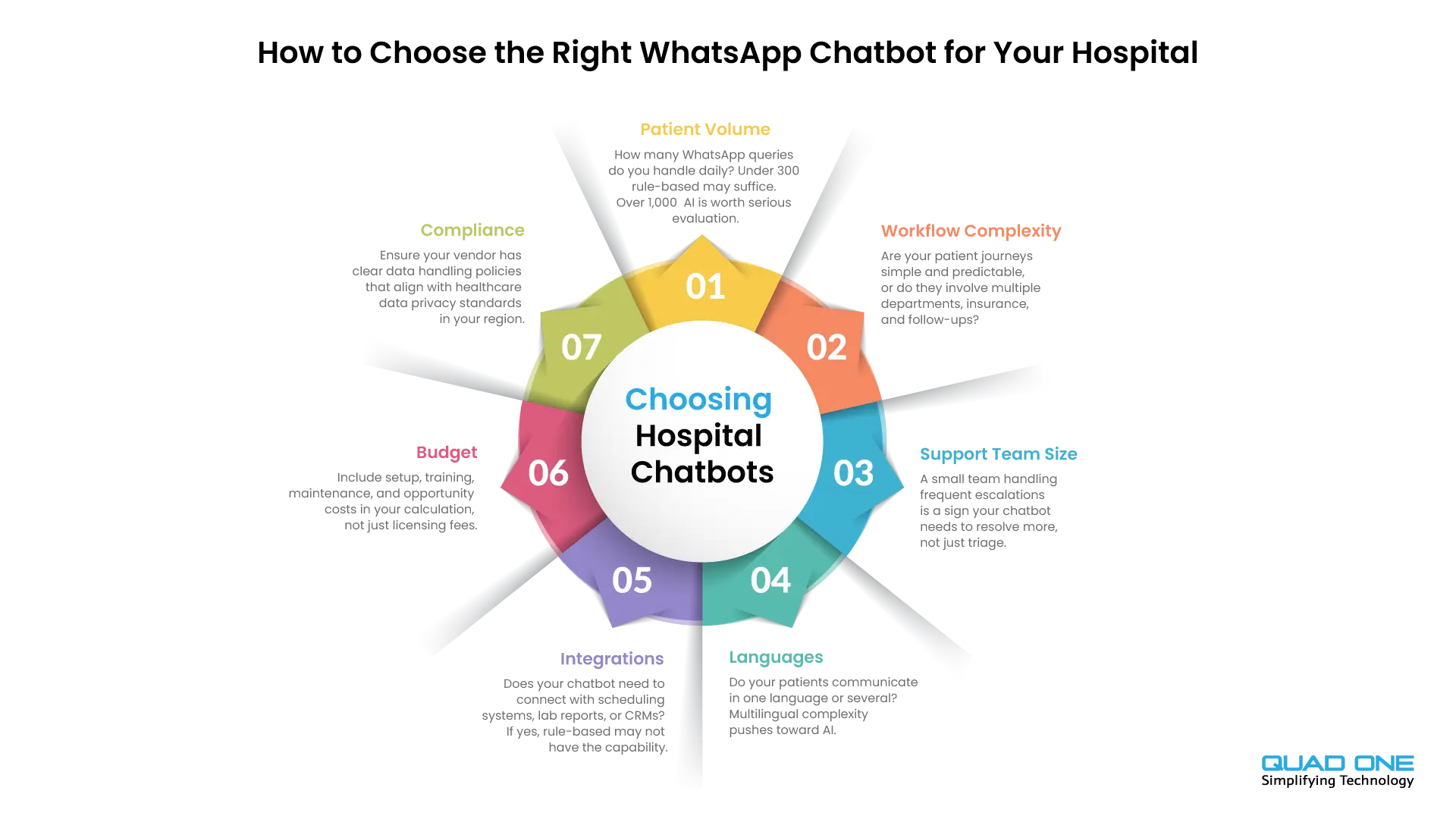
• Patient Volume: How many WhatsApp queries do you handle daily? Under 300 rule-based may suffice. Over 1,000 AI is worth serious evaluation.
• Workflow Complexity: Are your patient journeys simple and predictable, or do they involve multiple departments, insurance, and follow-ups?
• Support Team Size: A small team handling frequent escalations is a sign your chatbot needs to resolve more, not just triage.
• Languages: Do your patients communicate in one language or several? Multilingual complexity pushes toward AI.
• Integrations: Does your chatbot need to connect with scheduling systems, lab reports, or CRMs? If yes, rule-based may not have the capability.
• Budget: Include setup, training, maintenance, and opportunity costs in your calculation, not just licensing fees.
• Compliance: Ensure your vendor has clear data handling policies that align with healthcare data privacy standards in your region.
Conclusion
The right chatbot depends on a hospital’s size, workflows, and patient needs. Small clinics with predictable processes may operate effectively with rule-based chatbots, while larger multi-specialty hospitals with growing, multilingual patient bases often need AI chatbots for greater flexibility and scalability.
Rule-based chatbots are reliable and structured, whereas AI chatbots offer intelligence and adaptability but require stronger investment and planning. Hospitals should avoid choosing AI for trend value or staying with rule-based systems out of caution. Instead, decisions should be based on workflow complexity, patient expectations, and long-term scalability to reduce friction for both patients and staff today and in the future.
For a broader look at how AI WhatsApp chatbot technology supports appointment booking, reminders, patient engagement, and admin efficiency, read our guide on AI WhatsApp chatbot for healthcare.
External References