The healthcare industry places a strong emphasis on data security, making compliance and risk management a top priority. This content explains SOC 2 Type I and Type II reports in the context of healthcare organizations, highlighting their purpose, differences, and suitability. It also covers the importance of vendor management in maintaining data security and compliance, especially when working with third parties. Additionally, it outlines factors that impact SOC 2 audit timelines, common causes of delays, and practical steps organizations can take to streamline the audit process and achieve compliance efficiently.
Key Takeaways:
- Conducting a readiness assessment helps identify gaps early and ensures a smoother audit experience.
- SOC 2 Type I evaluates the design of security controls at a specific point in time, while Type II assesses their effectiveness over a period.
- Type I is ideal for early-stage or low-risk vendors, whereas Type II is preferred for organizations handling sensitive healthcare data.
- Vendor management is critical in SOC 2, as third parties can directly impact data security, compliance, and risk exposure.
- Common audit delays include scope creep, missing documentation, and lack of internal coordination.
- Proper scoping, clear documentation, defined ownership, and automation can significantly speed up the SOC 2 process.
SOC 2 Type I vs Type II Explained for Healthcare Organizations
Healthcare organizations handle highly sensitive data, making strong data protection essential. This is where SOC (System and Organization Controls) comes into the picture. SOC frameworks help ensure that proper security measures are in place to safeguard patient information. There are two main types of SOC reports, each serving a different purpose.
Type I
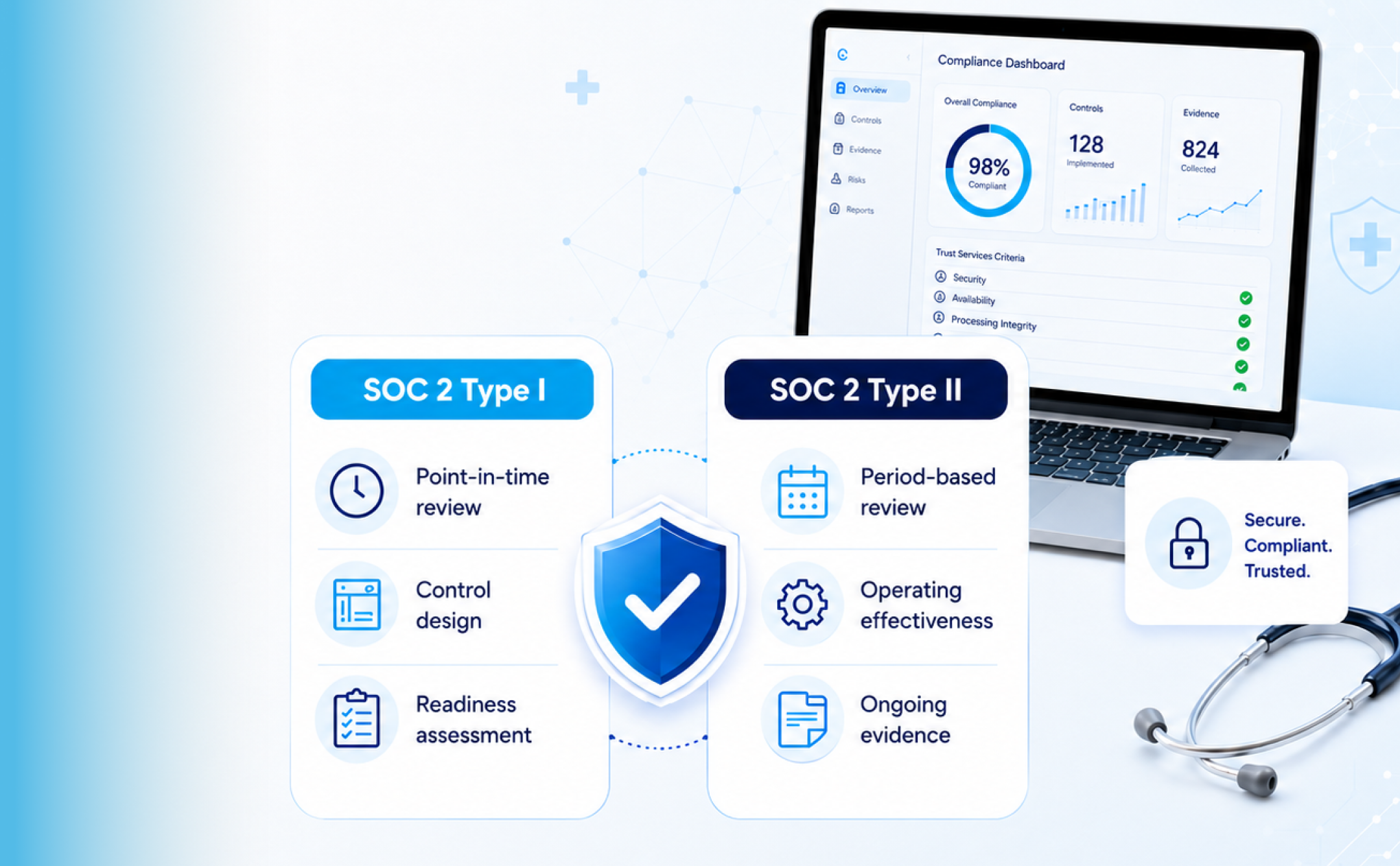
SOC 2 Type I checks whether the right security controls are in place at a specific point in time. It focuses on the design of your systems and processes, ensuring that proper measures like access controls, data protection policies, and monitoring systems are set up correctly.
This type of audit is especially suitable for new vendors or startups that are just beginning their compliance journey. It helps them demonstrate to clients and partners that they have a strong security foundation, even if they haven’t yet proven performance over time.
In terms of cost, a SOC 2 Type I audit typically ranges from $20,000 to $60,000, depending on factors like company size, complexity of systems, and the scope of the audit.
Type II
On the other hand, SOC 2 Type II goes a step further than Type I. It not only evaluates whether security controls are properly designed, but also tests their effectiveness over a period of time (usually 3 to 12 months).
Because of this deeper level of validation, Type II is especially suitable for vendors that handle highly sensitive data, such as healthcare platforms, cloud service providers, and SaaS companies working with patient or financial information. It provides stronger assurance to customers that data is being securely managed on an ongoing basis.
In terms of cost, SOC 2 Type II is more expensive than Type I, typically ranging from $35,000 to $100,000, depending on the organization’s size and complexity.
What Is SOC 2 Vendor Management?
SOC 2 vendor management is all about how a company safely shares its data with third-party vendors. It means ensuring that whenever data leaves your system, it’s still protected and handled responsibly, especially when it includes sensitive information such as customer, financial, or healthcare data.
Instead of blindly trusting vendors, companies carefully select them, review their security practices, and monitor them over time. Clear rules are set on how data should be stored, used, and protected, so there’s no ambiguity.
At its core, it’s about reducing risk and ensuring that even outside your organization, your data is treated with the same level of care and security.
Differences Between Type I and Type II
| Aspect | Type I | Type II |
| Purpose | Evaluates whether the right security controls are in place | Evaluates both the design and effectiveness of controls |
| Timeframe | Point-in-time assessment | Assessed over a period (usually 3 to 12 months) |
| Focus | Design of systems and processes | Performance and consistency of controls over time |
| Best For | Startups or new vendors beginning their compliance journey | Organizations handling highly sensitive data regularly |
| Use Case in Healthcare | Demonstrates basic security readiness | Provides strong assurance for handling patient data securely |
| Level of Assurance | Moderate | High |
| Audit Depth | Checks if controls exist | Checks if controls work effectively over time |
The Importance of Vendor Management in SOC 2 Compliance
SOC 2 vendor management is critical in determining the type of vendors a company chooses, as it directly impacts how sensitive data is handled, whether it is protected responsibly or exposed to risk. Since organizations often share data with third parties, ensuring vendors follow strict security and compliance standards is essential. During a SOC 2 audit, companies must demonstrate that their vendor relationships do not introduce vulnerabilities and that all controls are in place to avoid failure.
Key factors to consider when evaluating vendors include:
Vendor risk management: Involves ongoing monitoring and evaluation of vendors to minimize risks and maintain compliance.
SOC 2 for healthcare vendors: Ensures vendors handling sensitive healthcare data meet strict compliance and security standards.
Healthcare vendor compliance: Verifies that vendors align with industry regulations and protect patient information effectively.
Trust Services Criteria: Forms the foundation of SOC 2, covering security, availability, confidentiality, processing integrity, and privacy.
Security controls: Assesses the safeguards vendors have in place to protect data from unauthorized access or breaches.
Processing integrity: Ensures systems process data accurately, completely, and reliably.
Healthcare SaaS vendors: Require additional scrutiny due to continuous data exchange and cloud-based operations.
What Qualifies as a Vendor in SOC 2 Vendor Management?
In SOC 2 vendor management, a vendor refers to any external organization or individual that interacts with your company’s data, whether by accessing, storing, processing, or supporting the systems that handle it. This can include cloud service providers, SaaS platforms, IT support teams, payment processors, and even consultants with system-level access. The focus is not simply on the term “vendor,” but on the role they play in your data ecosystem.
A practical way to identify a vendor is by asking whether the third party can impact the security, availability, or compliance of your data. If they have the potential to influence how your data is handled or protected, they fall within the scope of SOC 2 vendor management. As a result, such vendors should be carefully evaluated, continuously monitored, and properly managed to ensure data protection and compliance.
Building Trust with Healthcare Delivery Organizations
Hospitals and health systems are, understandably, skittish about third-party risk. Every vendor with access to patient data is a potential doorway into their network, and security teams know it.
A SOC 2 report shortcuts a lot of the back-and-forth. Instead of a healthcare delivery organization sending over a 200-question security questionnaire and waiting weeks for answers, a vendor can hand over an independently audited report that answers most of it upfront. It signals maturity: this isn’t a company scrambling to bolt on security after a breach; it’s one that’s built it into its operations.
In a market where procurement cycles are already slow and risk-averse, SOC 2 compliance often becomes the difference between getting a meeting and getting filtered out before one even happens.
When Should Healthcare Vendors Choose Type I vs Type II?
Healthcare vendors should choose SOC 2 Type I when they need a quick, point-in-time validation of their control design, especially in the early stages of compliance. SOC 2 Type II is more suitable when they want to demonstrate ongoing effectiveness of controls over time, which builds stronger trust with clients and regulators.
Type I for Early-Stage or Low-Risk Vendors
Type I is essentially a snapshot: it confirms that your controls are properly designed at a single point in time. Think of it as showing your homework: “here’s what we’ve built, and here’s why it should work.”
This makes it a sensible starting point for newer healthcare vendors, or those with lower-risk data exposure, who need to demonstrate credibility without the time and cost of a full Type II audit. It’s faster to obtain and gives smaller companies something concrete to show prospective customers while they mature their security program.
The tradeoff is that Type I doesn’t prove those controls actually worked over time, just that they existed and looked sound on paper.
Type II for Established or High-Risk Vendors
Type II raises the bar considerably. Instead of a point-in-time check, auditors evaluate whether your controls operated effectively over a period, usually 6 to 12 months. It’s the difference between showing a workout plan and showing six months of gym check-ins.
For vendors handling large volumes of PHI, integrating deeply into clinical workflows, or serving enterprise health systems, Type II is often the expectation rather than the exception. Healthcare buyers increasingly ask for it by name, because it proves consistency, not just intention.
Yes, it takes longer and costs more. But for vendors positioning themselves as serious, long-term players in healthcare IT, Type II compliance tends to pay for itself in shortened sales cycles and fewer security objections.
Factors That Affect Your SOC 2 Timeline and How to Move Faster
SOC 2 timelines can vary widely depending on how well your organization is prepared. Factors like scope, documentation, and internal coordination can either speed up the process or cause delays. Understanding these elements helps you plan better and move through the audit more efficiently.
What Slows Down a SOC 2 Audit
Ask five vendors how long their SOC 2 took, and you’ll get five different answers, usually followed by a sigh. The timeline swings wildly based on a handful of predictable culprits.
Scope creep is the biggest one. The more systems, vendors, and data flows you pull into the audit boundary, the more evidence you need to gather, and the longer everything takes. Vendors who haven’t
mapped their environment ahead of time often discover mid-audit that they’ve included things they didn’t need to.
Missing documentation is a close second. If policies exist only in someone’s head or in a Slack thread from 2023, the audit stalls while you scramble to formalize them. Auditors can’t verify a control that isn’t written down anywhere.
How to Accelerate Your SOC 2 Timeline
The good news is that most delays in a SOC 2 audit are avoidable with the right preparation and approach.
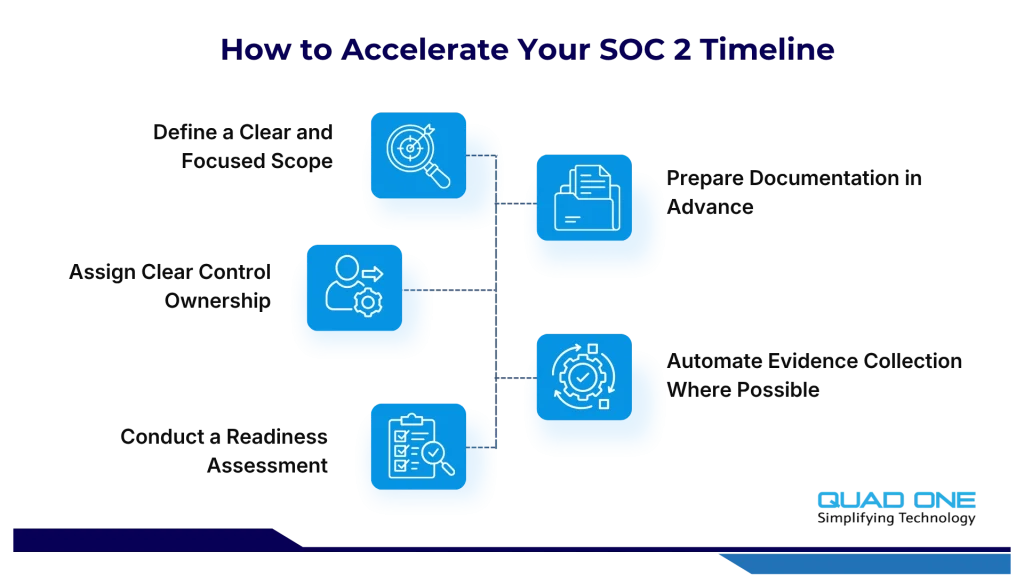
1. Define a Clear and Focused Scope
- Include only the systems and processes that directly interact with the relevant data
- Avoid unnecessary expansion of the audit boundary.
- A well-defined scope reduces evidence requirements and minimizes complexity.y
2. Prepare Documentation in Advance
- Ensure all policies and procedures are formally documented
- Keep supporting evidence readily available before the audit begins
- Avoid creating documentation reactively during the audit process
3. Assign Clear Control Ownership
- Identify and assign control owners early in the process
- Clearly define responsibilities for each control and evidence requirement
- Prevent delays caused by unclear ownership or internal coordination gaps
4. Automate Evidence Collection Where Possible
- Reduce reliance on manual tasks such as screenshots and log tracking
- Use tools that automatically collect and maintain audit-ready evidence
- Improve efficiency and consistency throughout the audit lifecycle
5. Conduct a Readiness Assessment
- Perform an internal review before the official audit begins
- Identify and address gaps proactively
- Ensure smoother execution and reduce last-minute surprises
By taking these steps, organizations can streamline their SOC 2 audit process, reduce delays, and achieve greater efficiency with less stress.
Conclusion
Achieving SOC 2 compliance in healthcare requires more than just implementing controls; it demands a strategic approach to scope, documentation, and vendor management. Choosing between Type I and Type II depends on the organization’s maturity and risk exposure, while proactive planning can significantly reduce audit timelines. By focusing on preparation, clarity, and efficiency, organizations can not only meet compliance requirements but also build stronger trust with clients and stakeholders.
In a highly regulated and trust-driven industry like healthcare, SOC 2 compliance also serves as a competitive advantage. It not only reassures clients about data security but also helps streamline vendor evaluations, accelerate sales cycles, and strengthen long-term business relationships.
External References