
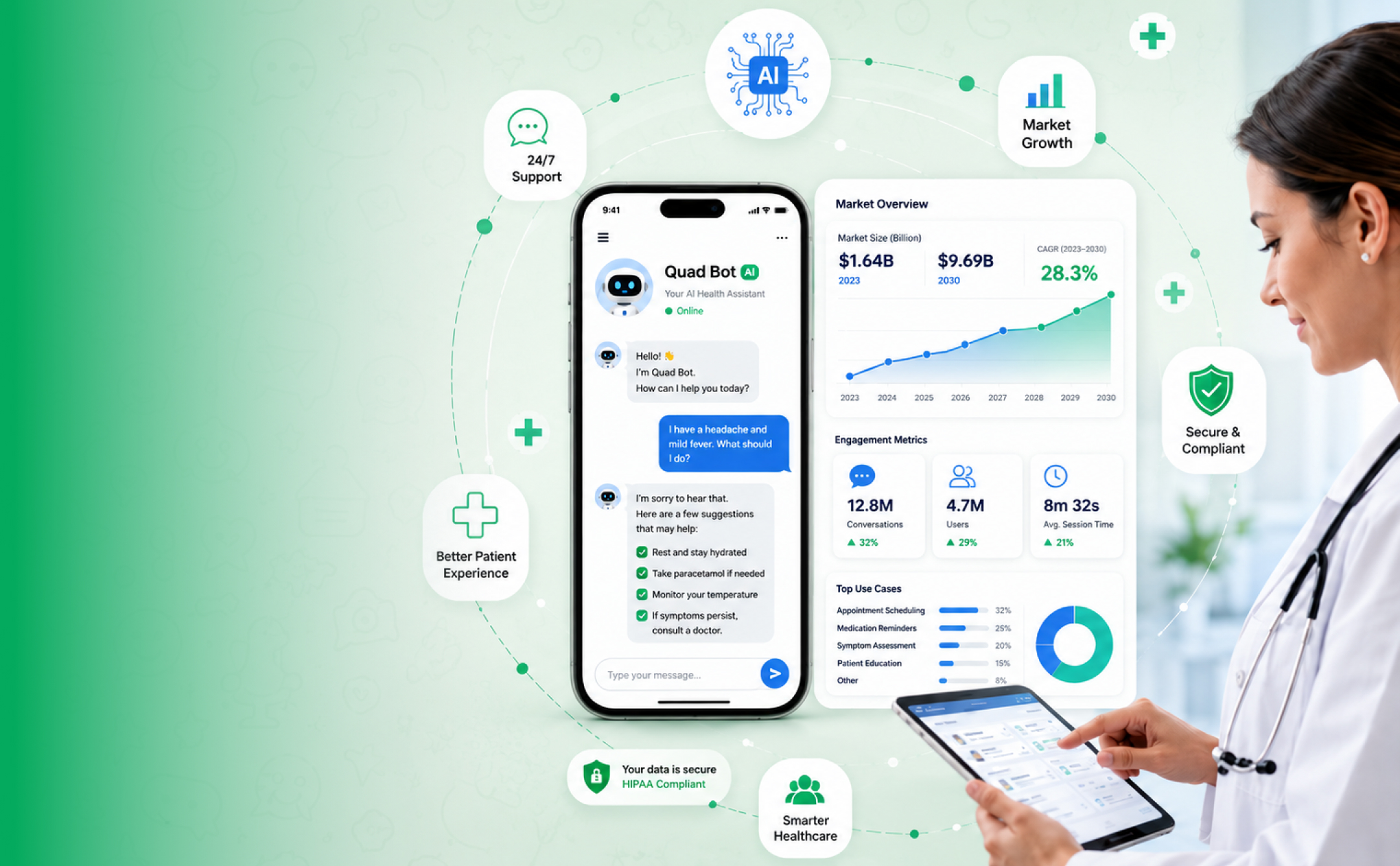
Healthcare chatbots are transforming healthcare by improving accessibility, efficiency, and patient engagement. Powered by AI and natural language processing, they help with symptom checking, appointment scheduling, mental health support, billing, reminders, and administrative tasks.
The market is growing rapidly in 2026, driven by rising healthcare demand, workforce shortages, and the expansion of telehealth. Modern chatbots are evolving from simple FAQ tools into intelligent virtual assistants that integrate with EHRs, CRM systems, scheduling platforms, and hospital workflows. Growth is also supported by increasing adoption across regions such as the U.S., Europe, India, and Asia-Pacific, with major healthcare and technology companies driving innovation.
Key Takeaways:
- Healthcare chatbots are rapidly transforming patient care and healthcare operations
- Market growth is driven by AI advancements, rising patient demand, and staff shortages
- Chatbots improve accessibility by providing 24/7 support to patients
- Major use cases include:
- Symptom checking and triage
- Appointment scheduling
- Mental health support
- Administrative automation
- They help reduce the workload for healthcare professionals and improve efficiency
- AI, NLP, and automation are making chatbots more accurate and intelligent
- Adoption is increasing across global regions, including the U.S., Europe, India, and Asia-Pacific
- The industry is shifting from standalone tools to integrated healthcare ecosystems
- Leading companies and tech firms continue to drive innovation and market expansion
Healthcare Chatbots are taking the domain to the next level, as it is predicted to grow from $0.54 billion in 2025 to $0.7 billion in 2026 at a compound annual growth rate (CAGR) of 29.6%. Chatbots have become extremely Prominent as they act like a bridge between hospitals and patients who rely on healthcare assistants these days, as it makes the task very simple, like scheduling appointments, inquiries, virtual consultations, and reminders. As it has now become AI all over, Healthcare Assistants have become a necessity.
For hospitals looking at patient-facing communication, an AI WhatsApp chatbot for healthcare can support appointment booking, reminders, FAQs, and real-time patient engagement.
Healthcare Chatbots Market :
The healthcare chatbots market has grown exponentially in recent years, driven by the increasing demand for accessible, efficient, and patient-centric care. These AI-powered solutions are now being widely adopted across hospitals, clinics, and digital health platforms to streamline communication and improve service delivery.
Healthcare chatbots play a critical role in symptom triage, where they assess patient inputs and guide users toward appropriate care pathways, reducing unnecessary hospital visits and easing the burden on healthcare professionals. Additionally, advancements in AI-driven language transcription, including text-to-voice and voice-to-text capabilities, enable seamless and inclusive communication across diverse patient groups, breaking language and accessibility barriers.
Healthcare Markets by Applications
Healthcare markets by applications refer to how technologies like AI chatbots in healthcare are used across functions such as patient care, appointment booking, and patient engagement. With the rise of AI healthcare chatbots and conversational AI in healthcare, these applications are improving efficiency and driving growth in the healthcare chatbot market size.

Symptom Triage and 24/7 Virtual Health Assistance
- Collects patient symptoms through guided questions
- Provides instant care recommendations (home care/doctor/emergency)
- Directs patients to the right specialist or department
- Available 24/7 as the first point of contact
- Reduces unnecessary hospital visits and workload
Patient Engagement and Mental Health Support
- Sends medication reminders and follow-ups
- Shares personalized health tips and wellness plans
- Enables continuous patient interaction beyond visits
- Offers basic mental health support (mood tracking, stress relief)
- Provides a safe, judgment-free space for users
Administrative Automation & Scheduling
- Automates appointment booking, rescheduling, and cancellations
- Checks doctor availability in real-time
- Sends automated reminders (WhatsApp, SMS, email)
- Handles FAQs and repetitive queries
- Reduces no-shows and front-desk workload
Billing, Insurance & Support Services
- Explains medical bills and cost breakdowns
- Assists with insurance eligibility and coverage
- Guides claim submission and documentation
- Shares payment links and reminders
- Provides real-time claim status updates
From symptom triage and appointment scheduling to reminders and patient support, QuadOne helps healthcare providers build AI chatbot workflows that reduce staff workload and improve patient access.
Explore AI WhatsApp Bot ➜Business Impact of AI Chatbots in Healthcare
AI chatbots are valuable not only because they answer patient questions, but because they improve measurable healthcare workflows. Hospitals can use chatbots to reduce repetitive front-desk calls, automate appointment reminders, reduce missed follow-ups, support after-hours inquiries, and improve patient response times.
Key metrics hospitals can track include:
- Average response time
- Query resolution rate
- Human escalation rate
- Appointment conversion rate
- No-show rate
- Call deflection rate
- Staff time saved
- Patient satisfaction score
To evaluate measurable business value, hospitals should track healthcare chatbot ROI using metrics such as response time, escalation rate, appointment conversion, no-show reduction, and staff time saved.
Healthcare Chatbot Adoption by End Users
At the user end, the healthcare market is driven by hospitals, clinics, and patients who directly use healthcare services. Growing demand for faster, more convenient care is driving providers to adopt digital solutions such as AI tools and telemedicine, while patients increasingly expect accessible, efficient healthcare experiences.
AI healthcare chatbots are leading adoption among providers.
Hospitals, clinics, and large health systems contribute the largest share to the healthcare chatbot market size because they operate in high-pressure environments with continuous patient inflow. Managing thousands of interactions daily from inquiries to follow-upsrequires scalable solutions. This is where AI healthcare chatbots play a critical role by acting as the first point of contact, ensuring patients receive timely responses while reducing dependency on manual intervention.
AI chatbot in healthcare reduces administrative workload.
A significant portion of healthcare operations involves repetitive, non-clinical tasks. An AI chatbot in healthcare can automate processes such as appointment booking and rescheduling, answering frequently asked questions, sharing test-preparation guidelines, and sending medication reminders. By handling these tasks efficiently, chatbots free up administrative and clinical staff to focus on higher-value responsibilities, ultimately improving productivity across departments.
Conversational AI in healthcare
It enables seamless, real-time communication between patients and providers across multiple channels like WhatsApp, websites, mobile apps, and even voice interfaces. Instead of long wait times or unanswered calls, patients receive instant, accurate responses. This not only improves operational flow but also ensures that critical information such as appointment confirmations or care instructions is delivered without delay.
A virtual health assistant ensures 24/7 accessibility.
A virtual health assistant acts as an always-available support system, bridging the gap between patients and providers outside regular hospital hours. Whether it’s answering late-night health queries, guiding patients through symptoms, or providing post-visit care instructions, these assistants ensure continuous access to care. This level of availability is especially valuable in improving patient trust and satisfaction.
Healthcare Market Trends Across Countries in 2026
The global healthcare market in 2026 is rapidly shifting toward digital, patient-centric, and efficient care models, driven by technologies like AI, telemedicine, and data analytics. While developed countries lead in adoption, emerging markets are using these tools to expand access and reduce system strain, all while addressing challenges such as rising costs and workforce shortages.
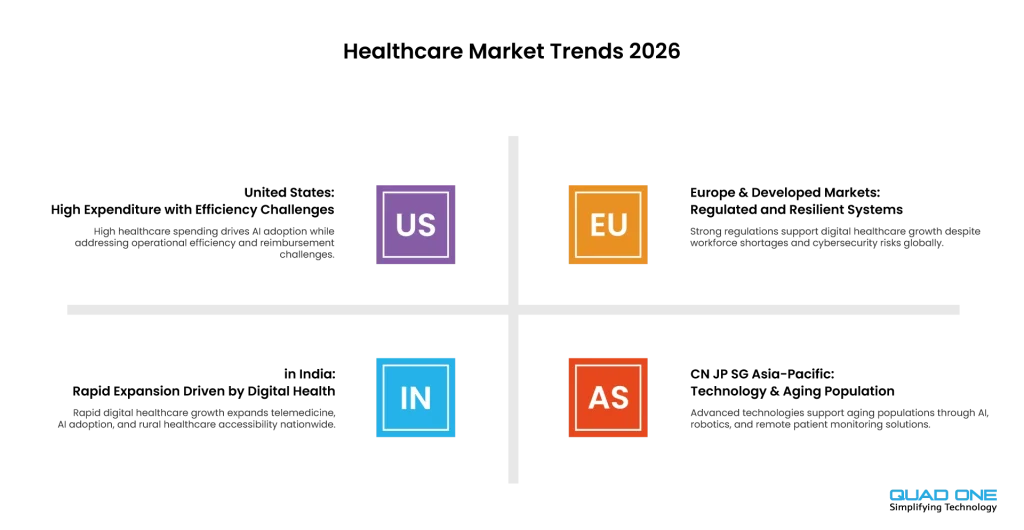
🇺🇸 United States: High Expenditure with Efficiency Challenges
- Total healthcare expenditure surpasses $4.5 trillion, accounting for ~18% of GDP
- Administrative costs contribute to 25-30% of total spending, significantly higher than peer nations
- Approximately 20% of healthcare executives report negative financial outlooks due to reimbursement pressures
- Telehealth utilization remains 5-10 times higher than pre-pandemic levels
- Over 60% of providers are investing in AI to optimize workflows and reduce costs
Research Insight:
Despite technological leadership, the U.S. healthcare system is under pressure to balance innovation with cost containment and operational efficiency.
🇪🇺 🇨🇦 🇦🇺 Europe & Developed Markets: Regulated and Resilient Systems
- More than 80% of healthcare leaders report positive growth outlooks
- Workforce shortages affect 30-40% of healthcare organizations
- Digital health adoption has increased by 40%+ since 2020
- Cybersecurity incidents in healthcare have risen by ~60% globally
- Strong regulatory frameworks (e.g., EU policies) guide safe AI and data usage
Research Insight:
These markets demonstrate stable growth, supported by regulation, but face structural workforce and cybersecurity challenges.
🇮🇳 India: Rapid Expansion Driven by Digital Health
- The healthcare sector is growing at ~22-25% CAGR, among the fastest globally
- Over 500 million smartphone users enable digital health penetration
- Telemedicine is expected to grow at 20%+ annually
- AI healthcare market projected to reach $1.5-2 billion by 2026
- Mobile health solutions expanding access to ~70% of rural populations
Research Insight:
India is leveraging digital infrastructure to scale healthcare access, effectively bypassing traditional system limitations.
🇨🇳 🇯🇵 🇸🇬 Asia-Pacific: Technology Integration and Aging Demographics
- Regional healthcare market growing at ~8-12% CAGR
- Japan’s elderly population exceeds 30% (aged 65+), increasing demand for long-term care.
- China continues large-scale investments in AI, robotics, and smart hospitals.
- Adoption of wearable and remote monitoring devices has increased by 35%+
Research Insight:
The Asia-Pacific region is combining advanced technologies with demographic-driven healthcare needs, especially in elderly care.
Market size estimates vary because research firms define the healthcare chatbot market differently. Some reports focus only on dedicated chatbot software, while others include conversational AI platforms, virtual assistants, services, and healthcare workflow automation. While the exact value differs by methodology, most reports agree on one direction: the healthcare chatbot market is growing quickly due to AI adoption, rising patient demand, and pressure to automate repetitive healthcare workflows.
Healthcare Chatbots by Market Insights:
Numbers vary a lot depending on which analyst firm you ask and how narrowly they define “chatbot,” but the direction is unmistakable. Mordor Intelligence pegs the healthcare chatbot market size at roughly $137 million in 2026, climbing to around $403 million by 2031, with a compound annual growth rate above 24%. Other research houses that count the market more broadly, including software layered on top of clinical workflows, put current figures well into the billions with similarly steep growth curves stretching out to 2034.
Healthcare Chatbots Key Market Insights:
Healthcare chatbots are reshaping the industry by turning healthcare from something you access occasionally into something that’s constantly available and responsive. Instead of waiting for appointments or spending time on calls, patients can instantly check symptoms, book visits, or get guidance anytime through a simple chat. This shift is not just about convenience; it’s helping healthcare systems handle growing patient demand more efficiently while also keeping patients engaged in their health daily. In many ways, chatbots are making healthcare feel less like a one-time interaction and more like an ongoing, supportive experience.
Challenges in Healthcare Chatbot Adoption
Despite strong growth, healthcare chatbot adoption comes with practical challenges. Hospitals need to ensure that chatbot responses are accurate, privacy-safe, and supported by a clear escalation path to human staff.
Common challenges include:
- Accuracy of symptom triage and medical guidance
- Privacy and secure handling of patient information
- Integration with EHR, CRM, scheduling, and hospital systems
- Multilingual support for diverse patient populations
- Avoiding over-automation in sensitive health situations
- Training and monitoring AI models over time
Hospitals planning deployment should also review a WhatsApp chatbot implementation guide to understand workflow mapping, escalation, integration, and compliance planning.
Latest Developments in the Global Healthcare Chatbots Market
Recent developments show clearly where healthcare chatbots are heading. Big tech companies are building smarter and more connected AI systems. In 2025, Microsoft introduced a Healthcare Agent Orchestrator that helps different AI tools work together across a patient’s entire care journey. At the same time, Google Cloud is developing AI tools specially designed to support healthcare operations.
Overall, these developments show a clear shift in the market. Healthcare chatbots are moving from simple, single-purpose tools to more advanced systems that can work together and connect directly with hospital workflows, making care more efficient and patient-friendly.
What are the factors on which the Healthcare Chatbots Market research is based?
Healthcare chatbot market research is typically based on a few key factors that help analysts understand how the market is growing. These include the type of component (software or services), deployment model (cloud-based or on-premises), end users (patients, healthcare providers, and insurers), and applications such as symptom checking, appointment scheduling, medication support, and general patient interaction.
In addition, researchers also consider broader industry trends like healthcare workforce shortages, rising investment in healthcare IT, and advancements in AI and natural language processing (NLP). These factors play a crucial role in determining how effective chatbot solutions are and how widely they are adopted over time.
Major Companies in the Healthcare Chatbots Market (2026)
As of 2026, the healthcare chatbot market is shaped by a mix of specialized AI health companies and global technology leaders, with a stronger focus on clinical integration and scalable enterprise solutions.
Key Players
- Ada Health -Continues to lead in clinically validated symptom assessment and patient-facing AI tools
- Infermedica – Expanding its AI-driven medical guidance platforms for providers and insurers
- Microsoft -Strengthening its presence with Azure Health Bot and advanced AI healthcare orchestration tools
- Sensely and Buoy Health – Established players in AI triage and symptom checking solutions
- GYANT, HealthTap, Quadone Technologies, and PACT Care – Focus on provider- and payer-oriented chatbot applications
AI chatbots are becoming a core part of digital healthcare ecosystems. QuadOne helps hospitals connect chatbot automation with CRM, patient engagement, and operational workflows.
Request a Demo ➜Conclusion:
Healthcare chatbots represent one of the biggest shifts in modern healthcare, moving the industry toward continuous, patient-centric care. By combining AI with real-time communication, they not only streamline operations but also empower patients with instant access to healthcare support. As technology advances and integration deepens, chatbots are expected to become a core component of digital healthcare ecosystems, improving both efficiency and overall patient experience while addressing global challenges like rising costs and workforce shortages.