Predictive analytics in healthcare helps hospitals anticipate patient risks, estimate future healthcare needs, and make better decisions using historical and current data. By analyzing information from electronic health records, lab reports, billing systems, and other sources, hospitals can identify patients who may need extra attention and prepare their resources accordingly.
From predicting hospital readmissions and missed appointments to planning bed availability, managing medical supplies, and identifying potential claim denials, predictive analytics supports both patient care and hospital operations. However, its effectiveness depends on good-quality data, accurate models, integration with existing healthcare systems, and regular monitoring to ensure the predictions remain reliable
Key Takeaways:
- Predictive analytics uses historical and current healthcare data to estimate future outcomes and risks.
- Common applications include early risk identification, readmission prediction, appointment no-show forecasting, and resource planning.
- Clean, connected, and reliable data is essential for generating useful predictions.
- Integrating predictive insights into EHR and HIS platforms helps healthcare teams act on them within their existing workflows.
- Data privacy, algorithmic bias, model accuracy, and clinical validation must be addressed before relying on predictions.
- Hospitals should start with a specific use case, measure outcomes against a baseline, and expand based on demonstrated value.
What Is Predictive Analytics in Healthcare?
Predictive analytics is the practice of analyzing historical data, current patient information, statistical methods, and machine learning to estimate what may happen in the future. In healthcare, it helps providers identify potential health risks, anticipate patient needs, and make informed clinical and operational decisions.
Example: A hospital builds a model from past discharge records, lab results, and medication history. When a heart failure patient is about to go home, the model scores their chance of returning within 30 days. A high score prompts a follow-up call, a medication review, and an early outpatient appointment before the patient leaves.
How Does Predictive Analytics Work in Healthcare?
Predictive analytics in healthcare uses historical patient data, medical records, and statistical models to identify patterns and estimate potential health risks. It helps healthcare providers anticipate what might happen next, such as identifying patients at risk of developing a disease, predicting hospital readmissions, or anticipating patient care needs. By using these insights, hospitals and healthcare professionals can make informed decisions, plan resources, and support timely patient care.
Step 1: Collect Healthcare Data
- Electronic Health Records (EHRs): Collect patient demographics, medical history, diagnoses, medications, allergies, and treatment records.
- Laboratory and Imaging Systems: Gather test results, scan reports, and other clinical findings to identify patterns associated with health conditions.
- Pharmacy and Billing Records: Use medication history, treatment costs, and claims data to understand patient care patterns and healthcare utilization.
- Wearables and Remote Monitoring Devices: Collect information such as heart rate, blood pressure, physical activity, and other health measurements where available.
Step 2: Clean and Integrate Data
- Remove Duplicate Records: Identify repeated patient entries and ensure records are linked to the correct patient.
- Handle Missing Information: Review incomplete records and determine how missing values should be managed without introducing misleading results.
- Standardize Data Formats: Align diagnosis codes, dates, medical terminology, and measurement units across different systems.
- Integrate Healthcare Systems: Combine relevant information from EHRs, laboratory systems, pharmacy platforms, and other sources to create a consistent dataset for analysis.
Step 3: Build and Validate Predictive Models
- Identify Relevant Data: Select the patient information and clinical factors associated with the outcome being predicted, such as hospital readmission or disease progression.
- Train Predictive Models: Apply statistical techniques or machine learning algorithms to historical data to identify patterns and relationships.
- Test Model Performance: Evaluate the model using data it has not previously encountered to determine how accurately it predicts outcomes.
- Validate Clinical Relevance: Work with healthcare professionals to assess whether predictions are clinically meaningful and check for differences in performance across patient populations.
Step 4: Generate Risk Scores and Forecasts
- Assess Individual Patient Risk: Estimate the likelihood of outcomes such as hospital readmission, complications, or disease progression within a defined period.
- Generate Risk Scores: Assign scores or risk categories to help healthcare professionals identify patients who may need closer monitoring.
- Forecast Hospital Demand: Predict future admissions, emergency department visits, bed occupancy, and staffing requirements using historical trends and other relevant data.
- Present Actionable Results: Display predictions through reports, dashboards, or alerts so healthcare teams can understand the results and decide on appropriate next steps
Step 5: Integrate Predictions into Healthcare Workflows
- Connect with EHR and HIS Platforms: Display predictive insights within the systems clinicians and hospital staff already use.
- Trigger Relevant Alerts: Notify authorized staff when a patient’s predicted risk crosses a defined threshold.
- Support Clinical Decisions: Help healthcare professionals prioritize patient reviews, plan follow-ups, and consider preventive interventions.
- Improve Resource Planning: Use demand forecasts to support bed allocation, staff scheduling, and inventory planning.
Step 6: Monitor Model Performance
- Track Prediction Accuracy: Compare predicted outcomes with actual results to assess how well the model performs.
- Review False Positives and Negatives: Investigate cases where the model flags patients unnecessarily or fails to identify those who experience the predicted outcome.
- Monitor Changes in Data: Check whether changes in patient populations, clinical practices, or data collection affect model reliability.
- Update and Revalidate Models: Retrain models when appropriate, test their performance again, and involve clinical and technical teams before deploying significant changes.
Types of Healthcare Analytics: Descriptive vs Predictive vs Prescriptive
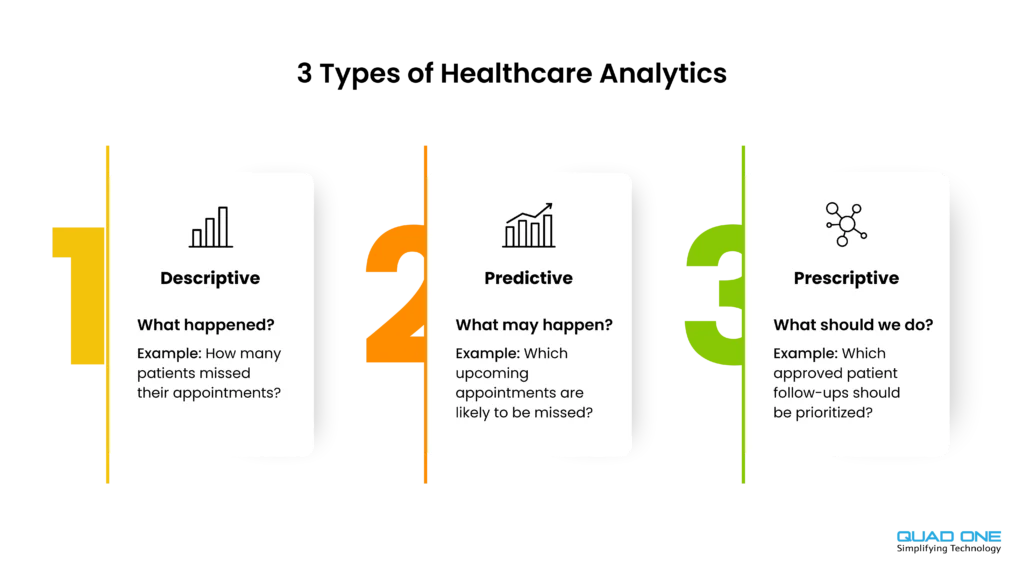
Predictive analytics in healthcare sits in the middle of a three-stage progression. Descriptive analytics explains the past, predictive analytics anticipates the future, and prescriptive analytics recommends what to do about it.
| Type | Question it answers | Healthcare example | Typical output |
| Descriptive | What happened? | Last quarter’s readmission rate by department | Reports and dashboards |
| Predictive | What is likely to happen? | Which discharged patients are most likely to return within 30 days | Risk scores and forecasts |
| Prescriptive | What should we do about it? | Recommending a follow-up plan for the highest-risk patients | Suggested actions |
Top Use Cases of Predictive Analytics in Healthcare
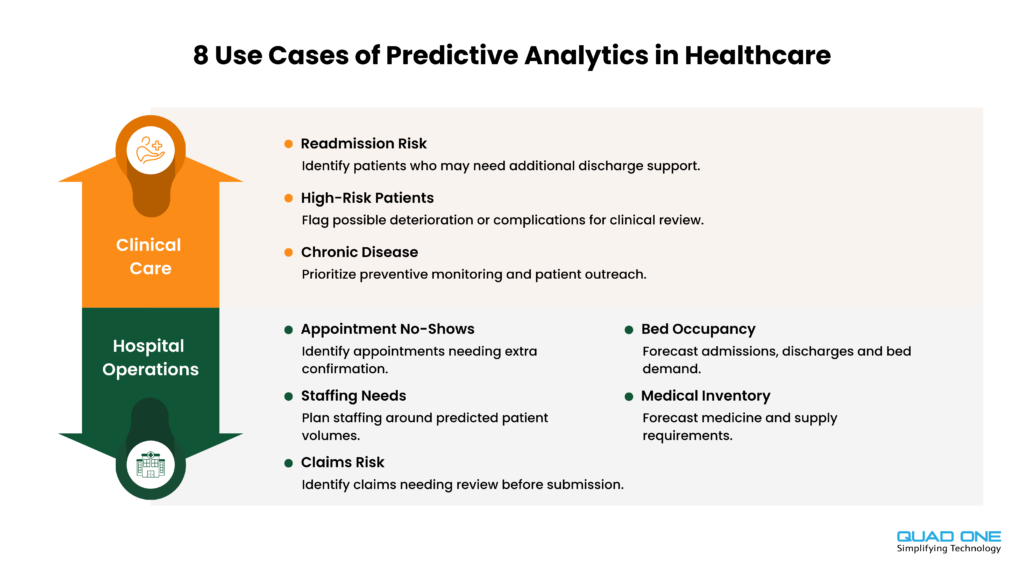
Predictive analytics helps hospitals use historical and real-time data to anticipate potential risks, identify patterns, and make informed decisions. From predicting patient admissions to reducing appointment no-shows, it supports better clinical planning and hospital operations. Here are the key use cases of predictive analytics in healthcare.
Predicting Hospital Readmissions
Readmissions are costly and often avoidable. In the United States, the Centers for Medicare & Medicaid Services runs the Hospital Readmissions Reduction Program, which reduces payments to hospitals with excess readmissions for conditions such as heart failure, pneumonia, and COPD. Models that identify patients likely to return let hospitals arrange extra discharge support, medication reconciliation, and timely follow-up.
Early Identification of High-Risk Patients
Models can scan vital signs, lab values, and history to flag patients who are at risk of deterioration, sepsis, or complications before symptoms become obvious. Earlier recognition gives clinicians time to intervene when treatment is most effective. These alerts must be tuned carefully, because too many false alarms cause alert fatigue and get ignored.
Predicting Appointment No-Shows
Missed appointments waste clinician time and delay care for patients who need it. Models that use appointment history, lead time, distance, and past behavior can estimate who is likely to miss a visit. Clinics can then send targeted reminders, offer transport support, or schedule backup patients in those slots.
Hospital Bed Occupancy and Patient Demand Forecasting
Forecasting admissions, emergency visits, and discharges helps hospitals plan beds days or weeks in advance rather than reacting during a surge. Seasonal illness, local events, and historical patterns all feed these forecasts, which reduce emergency department crowding and shorten waits.
Predicting Staffing and Resource Requirements
Once demand is forecast, staffing can follow it. Hospitals can match nurse and physician rosters to expected patient volume and acuity, plan operating theatre schedules, and anticipate equipment needs. This reduces both overstaffing costs and the burnout that comes from chronic understaffing.
Chronic Disease and Population Health Management
For conditions such as diabetes, hypertension, and chronic kidney disease, predictive models help identify patients whose condition is likely to worsen. Care teams can then prioritize outreach, adjust care plans, and focus preventive programs on the people who will benefit most, rather than treating a whole population the same way.
Medical Inventory and Supply Forecasting
Predicting consumption of medicines, blood products, consumables, and implants prevents both stockouts and expiry-related waste. Forecasts based on patient volume, procedure schedules, and seasonality help pharmacy and procurement teams order the right quantities at the right time.
Revenue Cycle and Claims Risk Prediction
Claim denials drain revenue and create rework. Models can flag claims likely to be denied because of coding errors, missing documentation, or authorization gaps, so staff can fix them before submission. The same approach can estimate payment timing and help prioritize collections.
Benefits of Predictive Analytics in Healthcare
- Identifies patients who may be at risk of developing health complications, allowing healthcare professionals to consider timely interventions.
- Helps clinicians use patient history and health data to support personalized treatment plans and care decisions.
- Forecasts patient admissions and demand to improve bed allocation, staff scheduling, and patient flow.
- Helps hospitals anticipate patient demand and allocate resources effectively, potentially reducing waiting times.
- Reduces avoidable readmissions, minimizes inventory waste, and improves staff utilization, helping control healthcare costs.
- Identifies patterns associated with claim denials and billing issues, helping hospitals address potential problems earlier.
- Supports timely care, proactive follow-ups, and treatment plans that reflect individual patient needs.
What Data Is Needed for Healthcare Predictive Analytics?
Clinical data forms the core: diagnoses, vitals, lab results, imaging reports, medications, procedures, and clinical notes. Administrative data adds admissions and discharges, appointment history, length of stay, and billing and claims records. Operational data covers bed status, staff rosters, and inventory levels.
Many programs also draw on patient-generated data from wearables and home monitoring, and on social and demographic factors such as age, location, and access to care, which strongly influence outcomes. Whatever the source, the data must be accurate, consistently coded, timely, and handled in line with privacy laws such as HIPAA.
Challenges and Risks of Predictive Analytics in Healthcare
Data quality and fragmentation come first. When records are scattered across disconnected systems, models see only part of the patient, and their predictions suffer. Integration is often the real project hiding behind the analytics project.
Bias is the second major risk. A widely cited 2019 study in Science by Obermeyer and colleagues found that a commercial risk algorithm underestimated the needs of Black patients because it used past healthcare spending as a stand-in for health need. A model is only as fair as the data and the target it is trained on.
Performance outside the lab is the third. An external validation of the Epic Sepsis Model, published in JAMA Internal Medicine in 2021, found it performed worse than the developer had reported and missed many sepsis cases. Models need local validation before they are trusted.
Finally, there are privacy and security obligations, clinician trust, alert fatigue, and the cost of the skills and infrastructure required. Models should support clinical judgment, not replace it, and their reasoning should be explainable to the people who rely on them.
How to Implement Predictive Analytics in Hospitals
Start with a single, specific problem tied to a measurable outcome, such as reducing 30-day readmissions for heart failure or cutting no-show rates in outpatient clinics. A narrow first project builds credibility faster than a hospital-wide program.
Next, assess the data that exists, fix quality gaps, and connect the systems involved. Bring clinicians, IT, and operations leaders into the project from the beginning, so the model answers a question people actually have. Build and validate the model on local data, run it quietly alongside current practice for a period, and then introduce it into the workflow with clear actions attached to each alert.
Set up governance early, covering who owns the model, who reviews its performance, how bias is checked, and how patient data is protected. Once the first use case proves its value, extend the same data foundation to the next one.
Technical metrics, such as how well the model separates high-risk from low-risk patients and how often its alerts are correct, show whether it works. They do not show whether it matters. Outcome metrics are the real test: readmission rates, length of stay, no-show rates, claim denial rates, wait times, and inventory waste, compared against a baseline taken before launch.
For return on investment, set the financial value of those improvements against the full cost of the program, including data integration, tooling, staff time, and ongoing monitoring. Track adoption too. If clinicians are not acting on the predictions, the benefit will not appear, however accurate the model.
How QuadOne Supports Connected Healthcare Data and AI Workflows
Predictive analytics in healthcare depends on connected data, and that is where QuadOne focuses. Prediction is only useful when information moves freely between the systems that hold it and when results appear inside the tools care teams already use.
QuadOne builds and integrates healthcare technology, including Hospital Information Systems, an AI-powered Hospital CRM, and WhatsApp-based patient engagement through WhatsApp ChatBot. By connecting these systems securely and in line with healthcare compliance requirements, QuadOne helps hospitals create the unified data foundation that analytics and AI workflows need, and put predictions to work in registration, scheduling, follow-up, and patient communication.
Build a Connected Data Foundation for Smarter Healthcare with QuadOne.
QuadOne connects healthcare systems to deliver reliable data and actionable insights.
Conclusion
Predictive analytics helps hospitals move from reacting to problems toward anticipating them. It can support earlier patient interventions, better resource allocation, and more informed financial decisions. However, meaningful results depend on more than the predictive model itself. Hospitals need reliable data, connected systems, clear workflows, and ongoing performance monitoring to turn predictions into practical improvements.
With the right data foundation and implementation strategy, predictive analytics can help healthcare organizations improve patient care while managing operational demands and costs more effectively.