When it comes to healthcare apps, building a great product is only part of the job. The bigger question is: how do you keep the patient information behind that app safe?
This is where HIPAA compliance comes in. From understanding what counts as PHI and ePHI to choosing the right technology, securing third-party services, and regularly testing the app, every part of development plays a role in protecting patient information.
The blog takes you through the practical side of building a HIPAA-compliant healthcare app and what to look for in a development partner. It also explores how AI, telemedicine, and EHR integration are changing healthcare apps and why security needs to keep pace with that change.
Key Takeaways
- Healthcare apps handle sensitive information, so privacy and security need to be considered from the start.
- Understanding PHI and ePHI helps determine how patient information should be stored, shared, and protected.
- Policies, employee training, access controls, risk assessments, and regular testing all play a role in HIPAA compliance.
- Any service that handles PHI should be properly reviewed and covered by the right agreements when required.
- Security needs to be reviewed and maintained as the app, technology, and healthcare needs change.
- Experience with healthcare apps, EHR integration, telemedicine, security, and HIPAA requirements can make a big difference.
What is HIPAA Compliance and Why Does It Matter to Healthcare Apps?
HIPAA, or the Health Insurance Portability and Accountability Act of 1996, sets important standards for protecting patient health information. For healthcare apps, following HIPAA guidelines helps keep sensitive data private and secure.
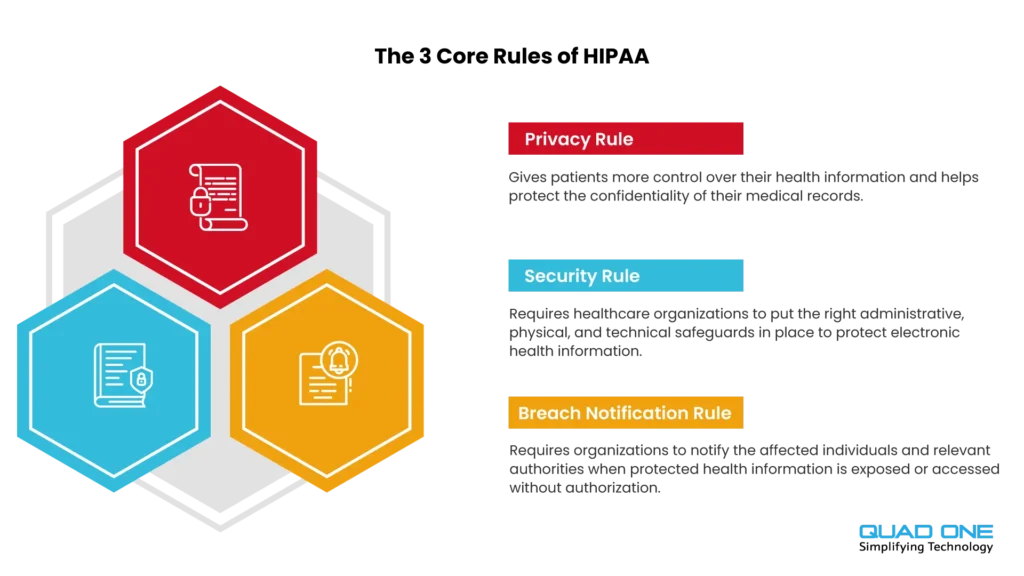
- Privacy Rule: Gives patients more control over their health information and helps protect the confidentiality of their medical records.
- Security Rule: Requires healthcare organizations to put the right administrative, physical, and technical safeguards in place to protect electronic health information.
- Breach Notification Rule: Requires organizations to notify the affected individuals and relevant authorities when protected health information is exposed or accessed without authorization.
When building a healthcare app in today’s digital world, security and reliability should be a priority. Since these apps handle sensitive patient information, strong security measures are important to keep data safe and maintain user trust. Regular updates and monitoring can also help the app stay secure, work smoothly, and keep up with changing healthcare needs.
At the same time, the app should be easy for patients and healthcare teams to use. A simple interface, quick response time, and easy access to important information can make everyday tasks much easier. When an app is secure, reliable, and user-friendly, it creates a better experience for everyone using it.
Types of Health Data and Regulatory Requirements
Not every piece of health-related data carries the same legal weight. Before writing a single line of code, it helps to separate what HIPAA actually covers from the broader universe of health data an app might collect.
Protected Health Information (PHI)
The U.S. Department of Health and Human Services defines protected health information as individually identifiable health information created, received, maintained, or transmitted by a covered entity or its business associate. That includes medical histories, diagnoses, treatment records, billing details, and demographic identifiers such as names, dates of birth, and contact information, in any form: electronic, paper, or spoken. When that same information exists in electronic form, it’s called ePHI and it’s ePHI that HIPAA’s Security Rule specifically governs through administrative, technical, and physical safeguards. Eighteen categories of identifiers, from Social Security numbers to biometric data, can turn ordinary health information into PHI the moment they’re attached to it.
Consumer Health Information
Not all health data collected by an app falls under HIPAA. Data gathered directly by consumer wellness apps, fitness trackers, or wearables outside a treatment relationship with a covered entity often sits outside HIPAA’s scope entirely, even though it’s sensitive. This is a common point of confusion for healthcare businesses building companion apps: a step counter or a sleep tracker may be regulated instead (or additionally) by the FTC’s Health Breach Notification Rule or state privacy laws. Knowing which bucket your app’s data falls into determines which rulebook you’re actually building to, and misclassifying it is one of the most common compliance gaps in health tech.
Want to build a HIPAA-compliant app for your healthcare business?
Quad One builds HIPAA-compliant healthcare software with built-in PHI protection.
Talk to Us ➜What Are the Benefits of Creating HIPAA-Compliant Healthcare Software?
Compliance is often framed as a legal obligation, but a HIPAA-compliant healthcare app also builds the kind of trust that keeps patients engaged and keeps healthcare organizations out of costly breach-response cycles.
The benefits of building to HIPAA standards are most visible in what they guarantee for the people whose data is on the line.
Protecting Patients’ Privacy
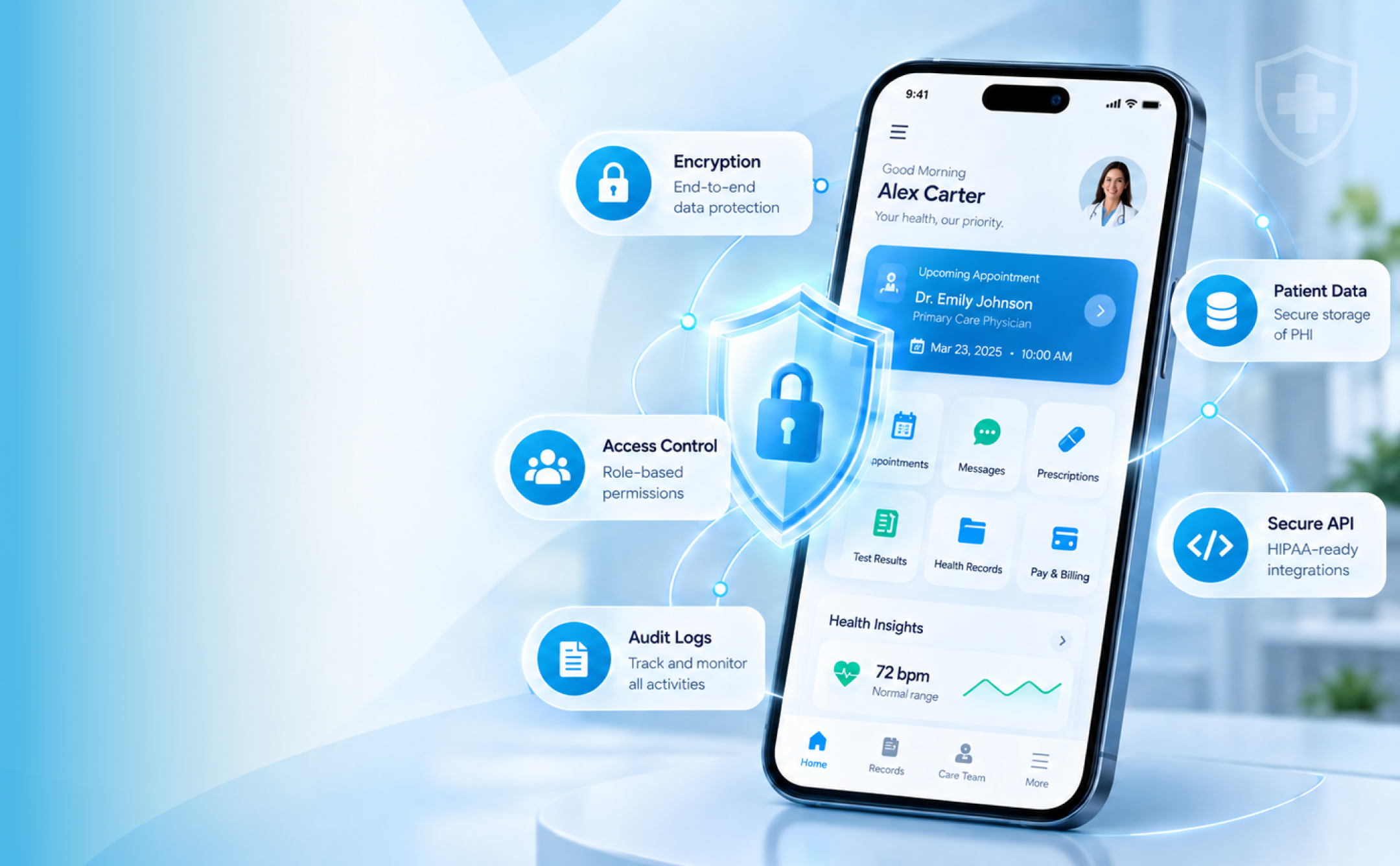
A HIPAA-compliant mobile application encrypts PHI in transit and at rest, enforces role-based access, and logs every interaction with patient records. That combination means a patient’s diagnosis, treatment plan, or lab results stay visible only to the people who are actually treating them.
Healthcare Parties Can’t Share the Information
HIPAA’s Privacy Rule restricts how covered entities and their business associates can use or disclose PHI, generally limiting sharing to what’s needed for treatment, payment, or healthcare operations and requiring patient authorization for most everything else. A compliant app builds these restrictions into its permission structure rather than relying on staff to remember the rules.
Notifying the Patients About Data Breaches
Under the HIPAA Breach Notification Rule, covered entities must notify affected individuals and, in larger cases, the Department of Health and Human Services and the media following a breach of unsecured PHI. A compliant app is built with breach detection and reporting workflows already in place, so if the worst happens, notification isn’t a scramble; it’s a documented process.
How to Build a HIPAA-Compliant App?
Building a HIPAA-compliant healthcare app is about protecting patient information at every stage, from Custom development and data storage to everyday use. Here are the key steps to follow:
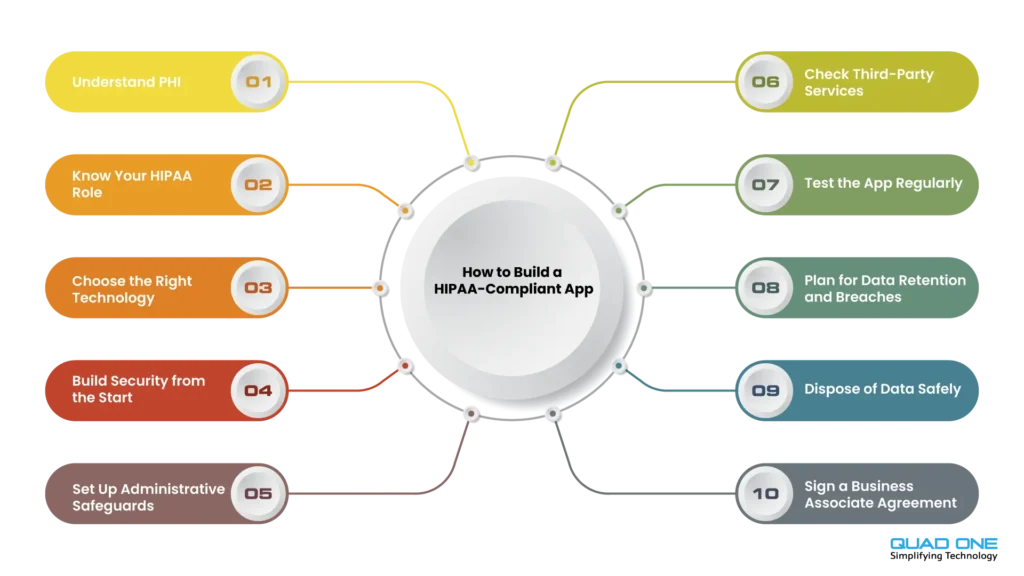
Step 1: Understand PHI
- Identify the protected health information (PHI) your app will collect or use.
- This may include names, medical records, test results, images, and appointment details.
- Understand where PHI enters the app, where it is stored, and how it is shared.
- Map these data flows before planning storage,
healthcare systems integration, or other app features.
Step 2: Know Your HIPAA Role
- Find out whether your organization is a covered entity or a business associate.
- Healthcare providers, health plans, and clearinghouses can fall under covered entities.
- A software company handling PHI for a healthcare organization may be a business associate.
- Knowing your role helps you understand which HIPAA requirements apply to your app.
Step 3: Choose the Right Technology
- Choose cloud platforms and services that support HIPAA requirements.
- Check whether the provider offers a Business Associate Agreement (BAA).
- Make sure the required security settings are enabled and properly configured.
- This is especially important for HIPAA-compliant mobile app development where patient data may move between different systems.
Step 4: Build Security from the Start
- Use encryption to protect data while it is stored and being transferred.
- Add secure login methods and access controls to limit who can view patient information.
- Use automatic session timeouts to reduce the risk of unauthorized access.
- Build these safeguards into the app from the beginning rather than adding them later.
Step 5: Set Up Administrative Safeguards
- Create clear policies for handling and accessing PHI.
- Give employees the right training on privacy and security practices.
- Regularly review who has access to sensitive patient information.
- Conduct risk assessments to identify areas where PHI protection in healthcare apps can be improved.
Step 6: Check Third-Party Services
- Make a list of every third-party service that may handle PHI.
- Check whether these vendors follow the required security practices.
- Sign a BAA with vendors when it is required.
- Pay close attention to services such as analytics, messaging, payment systems, and EHR integration.
Step 7: Test the App Regularly
- Test the app for security weaknesses before and after launch.
- Carry out regular vulnerability scans and security assessments.
- Review how the app protects electronic protected health information (ePHI).
- Fix security issues quickly instead of waiting for them to become bigger problems.
Step 8: Plan for Data Retention and Breaches
- Decide how long different types of PHI should be stored.
- Define how patient information will be archived and managed.
- Have a clear process for responding to a data breach.
- Make sure the right people know what to do if PHI is accessed without authorization.
Step 9: Dispose of Data Safely
- Do not keep patient information longer than it is needed.
- Securely delete electronic PHI when it is no longer required.
- Make sure old devices or storage systems are properly cleared before disposal.
- Keep physical documents containing PHI secure and destroy them appropriately when they are no longer needed.
Step 10: Sign a Business Associate Agreement
- Have a Business Associate Agreement (BAA) in place when required before handling live PHI.
- Clearly define how the healthcare organization and business associate will protect patient information.
- Outline each party’s responsibilities for security and breach reporting.
- Review these agreements regularly as the app, services, or data requirements change.
Why Do These Steps Matter?
Whether you are developing a HIPAA-compliant mobile application, a telemedicine app, patient portal, or an app connected through EHR integration, protecting PHI should remain a priority. Good security practices help protect patient information while also creating a safer and more reliable healthcare experience.
How to Choose a HIPAA-Compliant App Partner
Choosing the right development partner is just as important as following the right compliance steps. When patient data is involved, you need a team that understands both healthcare and technology.
- Look at their experience: Check whether they have worked on HIPAA-compliant healthcare apps, telemedicine apps, or projects involving EHR integration.
- Ask about security: Make sure they have experience protecting PHI and understand the security requirements that come with healthcare applications.
- Check their BAA process: A reliable partner should be comfortable signing a Business Associate Agreement (BAA) when required.
- Understand how they handle risks: Ask how they carry out security testing, risk assessments, and regular compliance checks.
- Check their technology choices: Make sure the cloud platforms, APIs, and third-party services they use can support HIPAA requirements.
- Think beyond the launch: HIPAA compliance is not something you check once and forget. Your development partner should be able to support security and compliance as the app grows and changes.
The right partner should be able to explain how they protect patient information in simple terms and show that security is part of their development process from the beginning.
Future Trends in Healthcare App Development
Healthcare app development is changing quickly, and HIPAA compliance needs to keep up with it. AI in healthcare is becoming more common in areas such as clinical documentation, patient support, and decision-making. As more healthcare apps use AI, protecting PHI and understanding how patient data is handled by these systems will become even more important.
EHR integration is also becoming more connected through standards such as FHIR, making it easier for healthcare apps to exchange information through APIs. At the same time, telemedicine apps are handling more patient information through virtual consultations and remote monitoring, creating a greater need for secure data sharing and storage.
Security will continue to be a major focus. Healthcare organizations are moving toward continuous monitoring, stronger access controls, and zero-trust security approaches to protect electronic protected health information (ePHI). As healthcare technology continues to grow, keeping patient data safe will remain an important part of building and maintaining healthcare apps.
Conclusion
Building a HIPAA-compliant app is ultimately about putting patient privacy and security first. From the way PHI is collected and stored to how it is shared and protected, every part of the app needs careful attention.
As healthcare continues to adopt AI, telemedicine, and connected systems, the need for secure healthcare apps will only grow. A strong approach to HIPAA compliance can help healthcare organizations protect patient information while building apps that people can trust and use with confidence.