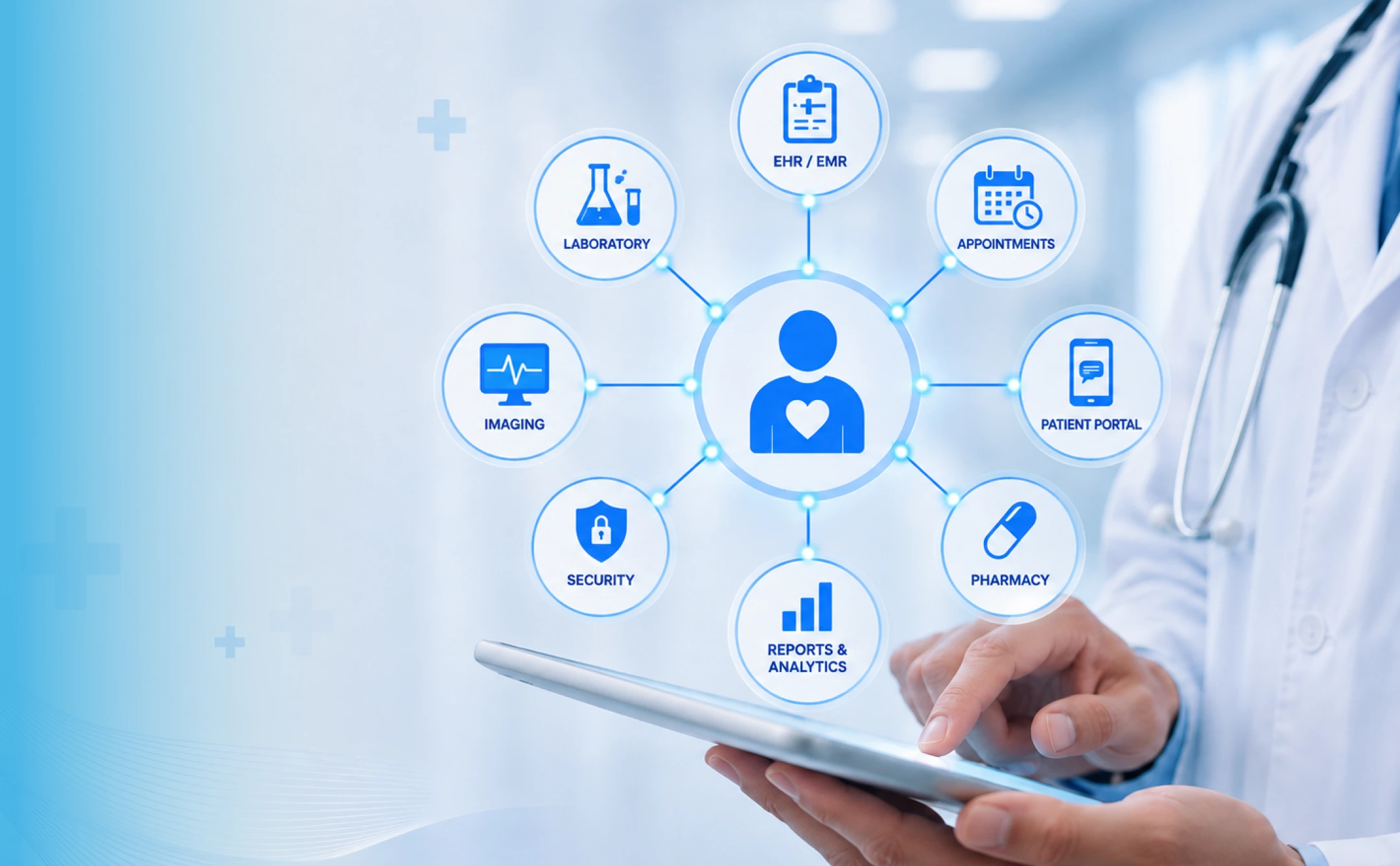
Healthcare runs on data, but when that data is scattered across EHRs, labs, billing systems, medical devices, pharmacies, and patient-facing platforms, its value is limited. Healthcare integration connects these disconnected systems so information can move securely, accurately, and in real time, creating a more complete view of the patient and a more efficient organization.
This guide breaks down the technology behind connected healthcare, from HL7, FHIR, and APIs to middleware, data transformation, and pre-built EHR connectors. It also explores why integration matters beyond IT: reducing operational costs, improving patient safety, enabling smarter analytics, supporting AI and automation, and strengthening continuity of care.
As healthcare ecosystems become increasingly complex, integration is no longer simply an IT initiative. It is the foundation for connected care, actionable data, scalable automation, and technology that can keep pace with the future of healthcare.
Key Takeaways:
- Healthcare integration connects the fragmented pieces of the patient journey, allowing EHRs, labs, billing systems, medical devices, pharmacies, and other platforms to exchange information seamlessly.
- Integration is becoming a necessity, not a nice-to-have. Disconnected systems create duplicate work, delayed information, data silos, and fragmented patient experiences.
- Interoperability depends on multiple technologies working together. HL7 and FHIR provide common standards, APIs enable communication, middleware manages data flow, and EHR connectors accelerate implementation.
- The value of integration extends beyond IT. Connected systems can reduce manual work and administrative costs while supporting better clinical decisions and patient safety.
- AI is only as useful as the data behind it. Integrated, complete, and current data gives AI, analytics, NLP, and automation the foundation they need to deliver meaningful results.
- Security must be built into integration from the start. Encryption, role-based access, audit logging, vulnerability testing, and data governance become increasingly important as more systems and endpoints are connected.
- Choosing the right integration partner matters. Healthcare organizations should look beyond technical capabilities and evaluate standards expertise, EHR connectors, security practices, pricing, references, and implementation timelines.
What is Healthcare Integration Software
Healthcare Integration Software acts as a bridge between different clinical and administrative systems within a healthcare organization. It connects systems such as EHRs, hospital information systems, laboratory systems, pharmacy platforms, billing systems, medical devices, and patient-facing applications, allowing them to exchange data seamlessly.
By bringing these systems together, healthcare organizations can reduce manual data entry, minimize errors, improve information accessibility, and streamline workflows. It also supports better patient services by ensuring that relevant and accurate patient information is available to the right teams when needed.
Why Healthcare Integration Is Now a Necessity
The average hospital runs dozens of disconnected applications: an EHR, a lab information system, a billing platform, scheduling tools, imaging archives, and increasingly, patient engagement and CRM software layered on top. Each one holds a slice of the patient story. Without healthcare data integration tying those systems together, that story stays fragmented, and every fragment costs someone time: a nurse re-entering vitals, a biller chasing a claim, a physician switching between systems, or a patient repeating their history for the third time in one visit.
As healthcare workflows become more digital and data-driven, these gaps become harder to ignore. Integration connects systems so information can move seamlessly across departments, reducing manual work, improving data visibility, and helping care teams make faster, more informed decisions.
Comparing Disconnected vs. Integrated Healthcare Systems
The difference comes down to how efficiently information moves. Disconnected systems create silos, delays, and extra manual work, while integrated systems enable seamless data flow, faster access to information, and more connected care.
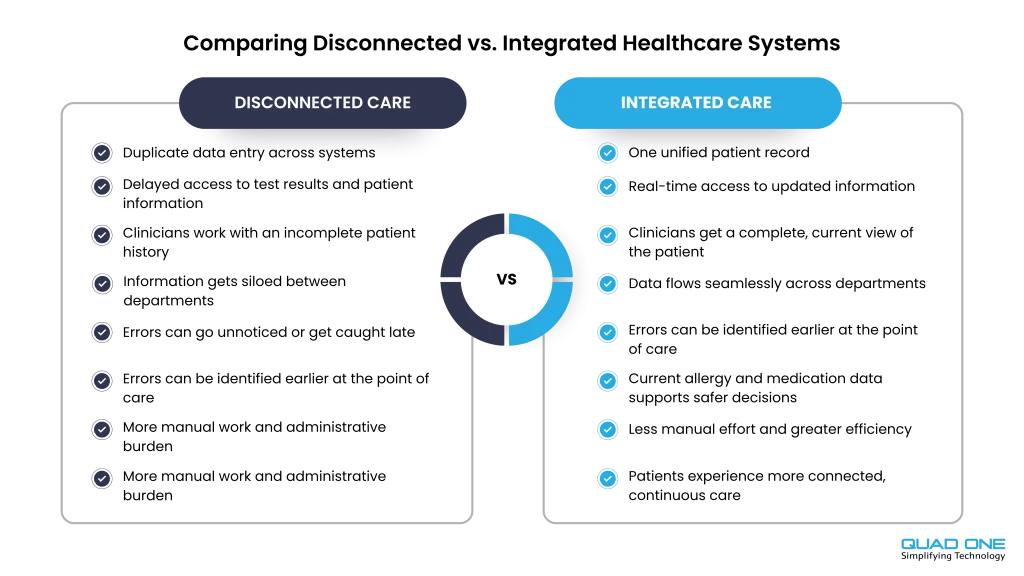
The impact extends beyond day-to-day workflows. When integration is treated as optional, organizations can end up paying the price through claim denials, avoidable readmissions, staff burnout, and other operational inefficiencies often long before those costs appear clearly in the IT budget.
The Building Blocks of Healthcare Data Integration
Healthcare data integration isn’t just about connecting one system to another. It relies on a combination of standards, protocols, APIs, interfaces, and data-mapping processes that allow healthcare systems to exchange information accurately, securely, and in real time.
From EHRs and hospital information systems to medical devices, laboratories, pharmacies, and patient-facing platforms, each component plays a role in keeping data moving where it needs to go.
The core components include:
- Interoperability Standards: HL7, FHIR, and DICOM help different systems communicate using a common language.
- APIs & Interfaces: Enable applications and platforms to securely exchange data and trigger actions.
- Data Mapping & Transformation: Converts data between different formats so information remains accurate across systems.
- Integration Engines: Route, process, validate, and monitor data moving between multiple healthcare applications.
- Security & Compliance: Encryption, authentication, access controls, and audit trails help protect sensitive health information.
- Real-Time Data Exchange: Ensures clinicians and care teams have access to the latest patient information when they need it.
- Monitoring & Error Handling: Identifies failed transactions, data discrepancies, and connectivity issues before they disrupt workflows.
Understanding these building blocks makes it easier to evaluate integration vendors, plan a scalable rollout, reduce data silos, and build a more connected healthcare environment.
HL7 and FHIR: The Common Language of Healthcare Interoperability
HL7 has long been the messaging standard that lets clinical systems exchange information admissions, discharges, lab results, orders in a structured, predictable format. FHIR (Fast Healthcare Interoperability Resources) is the newer, web-friendly evolution of that idea, built around modern API patterns that are far easier for developers to work with. Together, they form the common language underneath most healthcare interoperability efforts today, whether you’re connecting two internal systems or exchanging records with an outside provider network.
APIs: The Digital Messengers Behind Healthcare API Integration
If HL7 and FHIR are the language, APIs are the conversation. A well-designed API lets one system request exactly the data it needs from another: a patient’s latest lab result, an updated insurance record, an open appointment slot, without exposing everything else. Healthcare API integration is what turns static data stores into systems that can actually talk to each other in real time, which matters enormously for anything patient-facing, from portals to chatbots to remote monitoring tools.
Middleware: The Central Hub of Healthcare IT Integration
Most organizations don’t connect every system directly to every other system; that becomes unmanageable fast. Instead, middleware sits in the middle, translating formats, routing messages, and giving IT teams one place to monitor and troubleshoot data flow. Good middleware is what makes healthcare IT integration scalable: add a new system, and it plugs into the hub rather than requiring a fresh point-to-point connection to everything else.
EHR Connectors: Pre-Built Adapters for Faster EHR Integration
Building a custom connection to a major EHR platform from scratch is slow and expensive. Pre-built EHR connectors shortcut that work; they already understand the target system’s data model and API quirks, which means faster go-live, fewer surprises during testing, and lower long-term maintenance overhead. For most organizations, whether a vendor offers strong, pre-built EHR integration options is one of the first practical questions worth asking.
The Real Business Case for Healthcare Integration Solutions
Integration projects get funded when the business case is concrete, not aspirational. The good news is that the return on healthcare integration solutions shows up in two places finance and clinical leadership both care about: cost and outcomes.
Cutting Operational and Clinical Costs
Manual data entry, duplicate testing, and staff time spent chasing information across systems are all quiet cost centers. When systems are connected, staff stop re-keying the same data into three different applications, billing teams see fewer claim denials caused by mismatched or missing information, and IT spends less time firefighting point-to-point integrations that break every time one vendor pushes an update. None of these savings are dramatic on their own, but added together across a health system’s full patient volume, they’re substantial.
Improving Clinical Outcomes and Patient Safety
The clinical case is, if anything, more compelling than the financial one. A connected system means a physician sees the full medication list before prescribing, a care team is alerted the moment a critical lab value comes back, and a patient transferring between departments doesn’t lose context along the way. These aren’t edge cases; they’re the everyday moments where integration either catches a problem or lets one slip through.
Where AI and Automation Meet Healthcare Software Integration
Integration is also what makes AI in healthcare actually useful. A predictive model or an automation workflow is only as good as the data feeding it, and that data has to come from somewhere. Healthcare software integration is the plumbing that makes AI-driven care possible rather than theoretical.
From Reactive to Predictive: Smarter Analytics Through Integration
When data from across the organization flows into one place, analytics stops being a rear-view mirror and starts becoming a forecast. Integrated systems can flag a patient trending toward readmission, surface capacity crunches before they hit the ER, or highlight a population at rising risk all because the underlying data is complete and current, not siloed in whichever department happened to collect it.
Unlocking Unstructured Data with NLP
A huge share of clinical insight lives in free-text notes, discharge summaries, and physician dictation data that traditional systems can store but not really use. Natural language processing, layered on top of an integrated data environment, can extract structured insight from that unstructured text: flagging a symptom mentioned only in a note, or surfacing a risk factor that never made it into a coded field.
Automating High-Volume Workflows
Prior authorizations, appointment reminders, eligibility checks, routine follow-ups these are high-volume, rules-based tasks that consume enormous staff time. Once systems are integrated, automation can take on much of this work reliably, freeing clinical and administrative staff to spend their time on the parts of the job that actually need a human.
Security and Compliance in Integrated Healthcare Environments
Connecting more systems means more places where sensitive data moves, which is exactly why security can’t be an afterthought in any integration plan. A thoughtful approach to healthcare systems integration treats compliance as a design requirement from day one, not a checklist applied after the fact.
Core Security Measures Every Integrated System Needs
• End-to-end encryption for data both in transit between systems and at rest in storage
• Role-based access controls so staff only see the data relevant to their job
• Detailed audit logging across every integration point, not just the primary EHR
• Regular vulnerability testing on APIs and middleware, not just the core applications
• Clear data governance policies covering who owns, validates, and can modify shared data
Staying Ahead: Proactive Defense and Compliance Partnerships
Compliance frameworks like HIPAA set the floor, not the ceiling. Organizations that treat security as an ongoing partnership, regular audits, proactive threat monitoring, and a vendor that treats compliance as shared responsibility rather than something to hand off can catch problems long before they become breaches. That posture matters even more once integration expands the number of systems and endpoints in play.
Choosing the Right Partner for Healthcare Integration Services
Most organizations don’t build integration capability entirely in-house, and they shouldn’t have to. The right partner for healthcare integration services brings standards expertise, existing connectors, and a track record of doing this in environments as regulated as healthcare. The wrong one turns a straightforward project into a multi-year headache.
A Practical Vendor Selection Checklist
• Proven experience with HL7 and FHIR standards, not just general API work
• Pre-built connectors for the specific EHR and clinical systems already in place
• A clear, documented security and compliance framework, including HIPAA readiness
• Transparent pricing that accounts for ongoing maintenance, not just initial setup
• References from healthcare organizations of a similar size and complexity
• Realistic timelines and a willingness to phase the rollout rather than promise everything at once
Vendor Partnership vs. Building a Dedicated In-House Team
Building an in-house integration team gives organizations greater control and deep institutional knowledge, but it also requires significant time, resources, and ongoing investment as technologies and interoperability standards evolve.
Partnering with an experienced integration vendor offers a faster path to implementation, backed by specialized expertise and a proven track record of solving complex integration challenges. The right partner doesn’t operate as a black box; they work alongside your team, providing transparency, flexibility, and knowledge transfer.
For most organizations, the right vendor partnership can deliver connectivity faster, reduce long-term complexity, and provide the expertise needed to keep systems integrated as healthcare technology evolves.
Conclusion
The real challenge isn’t a lack of healthcare data; it’s making that data accessible where and when it matters.
Disconnected systems create gaps between information and action. Integration helps close those gaps by enabling data to move securely and efficiently across platforms, without relying on staff to bridge the connection manually.
That makes integration more than an IT initiative. It is the foundation for connected care, smarter automation, effective AI, and better-informed decisions. Organizations that approach integration strategically aren’t simply connecting systems; they’re creating a unified ecosystem where technology, data, and people can work together more effectively.