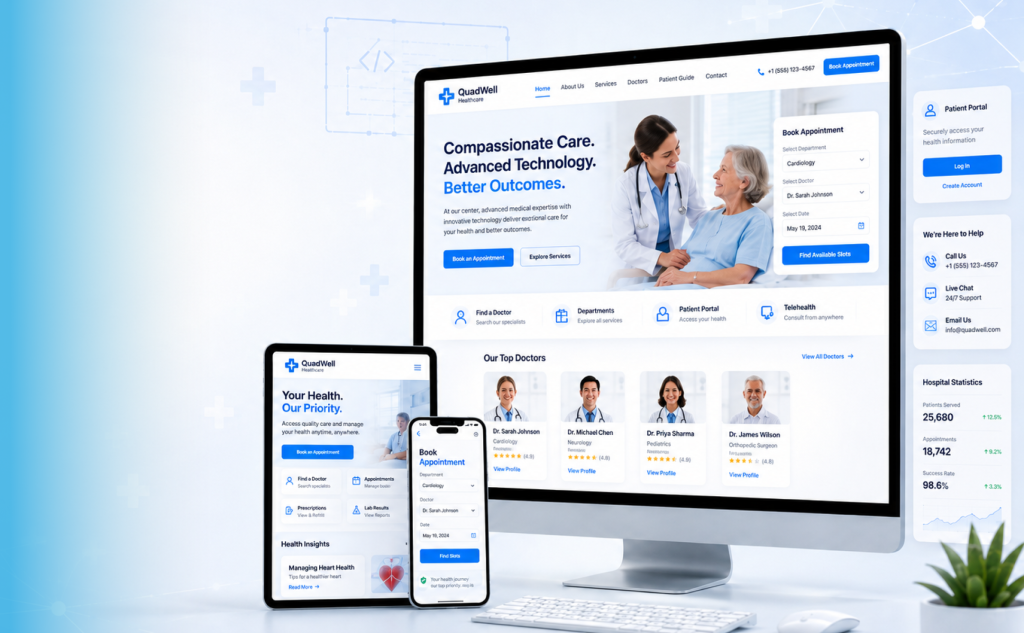
Healthcare lead generation is the process of attracting, capturing, nurturing, and converting potential patients or healthcare buyers into qualified inquiries, appointments, consultations, or sales opportunities. For clinics and hospitals, it includes channels such as SEO, paid ads, referrals, webinars, LinkedIn, reviews, WhatsApp, CRM workflows, and follow-up campaigns.
This guide is useful for clinics, hospitals, healthcare practices, and healthcare technology companies that want to attract the right audience, manage inquiries better, and improve lead-to-appointment or lead-to-sales conversion.
Key Takeaways
- Know your audience first: A hospital, clinic, doctor, or healthcare technology buyer can have very different needs, so lead generation should start with a clear customer profile.
- Understand the complete patient journey: Patient lead generation is not just about getting enquiries. It includes enquiry management, appointment booking, follow-ups, and the overall patient experience.
- Speak to different decision-makers: Clinical and IT teams may all look at a solution differently. Content should address their individual concerns.
- Healthcare leads need nurturing: Longer sales cycles mean that consistent communication and timely lead follow-up are important to keep prospects engaged.
- Trust matters: Healthcare organizations are careful about adopting new solutions. Case studies, testimonials, customer experiences, and useful industry content can help build confidence.
How to Build a Patient Lead Generation Strategy
Patient lead management is not just about building a strong brand or putting in consistent effort and waiting for results. At the heart of it is the patient and the journey they go through from discovering a healthcare provider to enquiring, booking an appointment, and eventually receiving care. A good patient lead strategy focuses on understanding this journey, responding at the right time, and making each step easier for both patients and healthcare teams.
It also means knowing where patients are coming from, what they are looking for, and what may influence their decision to choose a healthcare provider. With the right approach, hospitals can follow up with patients at the right time, reduce missed opportunities, and build a more consistent experience. Over time, this helps turn initial enquiries into meaningful patient relationships rather than treating every lead as just another number.
What Makes Healthcare Lead Generation Different?
Healthcare is a vast and complex field, with many steps involved in a patient’s journey. It starts from the moment a patient looks for a healthcare provider and books an appointment, and continues through registration, consultation, diagnosis, treatment, billing, follow-ups, and ongoing care. Every stage plays a role in shaping the patient’s overall experience.
It is not an easy task. Healthcare organizations need to keep patient information organized, ensure smooth communication between teams, and make sure patients receive the right support at the right time. Even a small gap in any part of the process can affect both the patient experience and the way healthcare teams work.
This is why healthcare management needs to look beyond individual services and consider the entire patient journey. When each step is planned and connected properly, hospitals and healthcare providers can make their processes more efficient while also making the experience simpler and more comfortable for patients.
Understanding the 5 key healthcare lead generation challenges
Healthcare lead generation can be a little more complicated than it looks. It is not just about finding potential customers and sending them a sales message. Healthcare organizations have different needs, multiple decision-makers, longer buying processes, and strict compliance requirements. Understanding these challenges can help businesses connect with the right people and build relationships that can actually turn into meaningful leads.
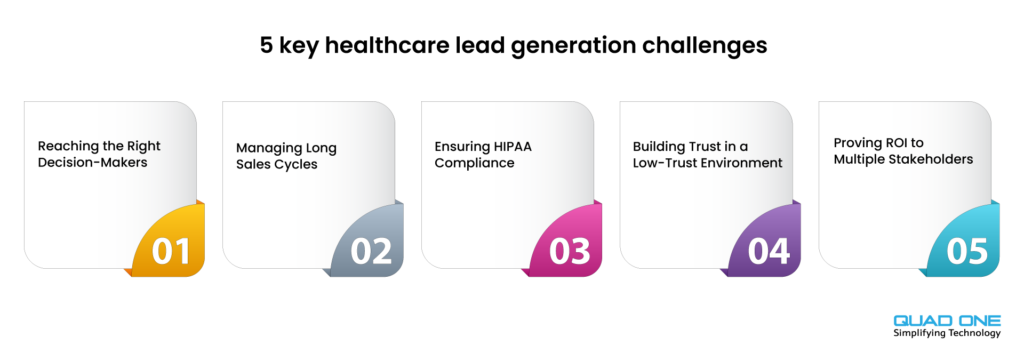
Reaching the Right Decision-Makers
- Healthcare organizations often have multiple people involved in a buying decision, making it difficult to reach the right person.
- A hospital administrator, IT director, and clinical head may have different priorities when evaluating a product or service.
- Reaching the right decision-maker requires understanding their roles, concerns, and how they influence the final decision.
Managing Privacy and Compliance Requirements
- Healthcare sales often take time because decisions involve multiple discussions, approvals, and evaluations.
- Hospitals may need to assess budgets, technical requirements, and how a solution fits into their existing workflows before making a decision.
- Without consistent communication and timely follow-ups, potential leads may lose interest or move on to other providers.
Managing Privacy and Compliance Requirements
- Healthcare companies must handle sensitive patient information carefully while managing their lead generation activities.
- Email campaigns, CRM platforms, chatbots, and other marketing tools must follow applicable privacy and security requirements.
- Maintaining compliance while collecting and managing lead information can be challenging, especially when multiple tools and teams are involved.
Building Trust with Healthcare Buyers and Patients
- Healthcare organizations are careful when choosing new vendors because their decisions can affect patient care, data security, and daily operations.
- They may hesitate to adopt a new solution without clear evidence that it works and meets their requirements.
- Sharing customer experiences, case studies, testimonials, and relevant industry knowledge can help address concerns and build confidence over time.
Proving ROI to Different Healthcare Stakeholders
- Different stakeholders measure the value of a healthcare solution in different ways.
- While hospital management may focus on cost savings and revenue, clinical teams may prioritize patient experience and workflow improvements.
- IT teams may be more concerned about EHR-CRM integration, security, and maintenance costs.
- Demonstrating how a solution meets these different expectations can make it easier to justify the investment and move the buying process forward.
Common Healthcare Lead Generation Channels
| Channel | How It Helps |
|---|---|
| SEO | Healthcare web development connects providers with patients and buyers searching for healthcare services and technology |
| Google Ads | Captures high-intent demand |
| Reaches healthcare decision-makers | |
| Webinars | Educates buyers and builds trust |
| Referrals | Generates high-trust leads |
| Website forms | Captures direct inquiries |
| Supports fast patient communication | |
| CRM campaigns | Helps nurture and re-engage leads |
10 Healthcare Lead Generation Strategies for Clinics and Hospitals
Healthcare buying has changed. Today, a hospital CIO may read industry reports, check what other healthcare professionals are saying on LinkedIn, and go through compliance checks before even speaking to a salesperson.
This means relying only on cold emails and a “Request a Demo” button may not be enough anymore. Healthcare organizations need a more thoughtful approach to reaching potential customers. Here are ten simple strategies that match the way hospitals, clinics, and payers research, compare, and choose technology today.
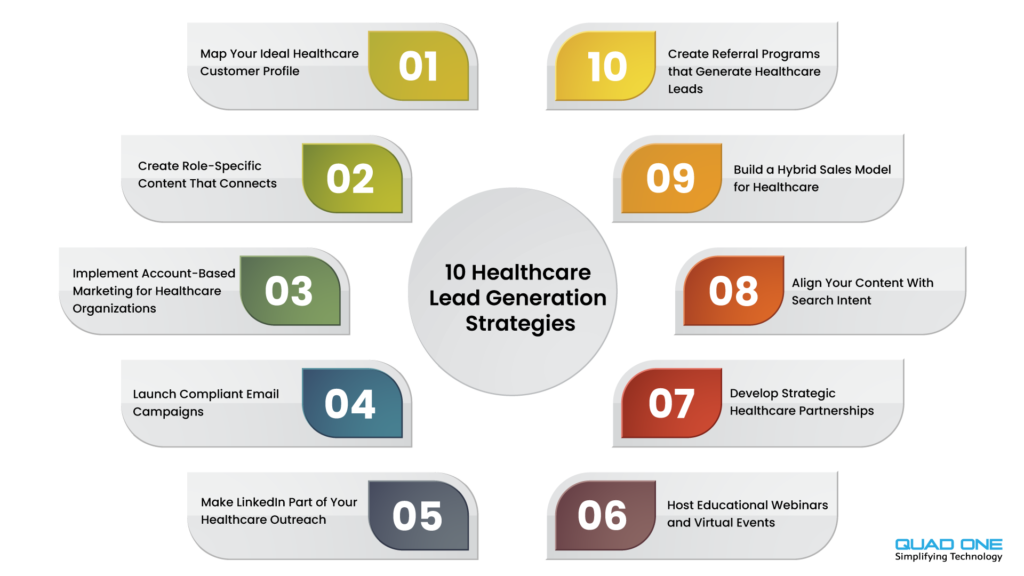
1.Map Your Ideal Healthcare Customer Profile
Before you write a single email or start a campaign, it is important to know exactly who you are trying to reach. The hospital is too broad to be a useful customer profile. A 200-bed regional hospital replacing its existing HIS will have very different needs from a multi-specialty clinic looking for its first AI-powered CRM. Start by understanding factors such as hospital size, patient volume, and existing EHR or HIS.
2.Create Role-Specific Healthcare Content
Healthcare buying decisions usually involve several people, and each stakeholder may have different priorities. A clinical leader may prioritize workflow and patient safety, while an IT director may focus on integration, security, and technology. A CFO, on the other hand, may want to understand costs and expected returns. Instead of creating one generic piece of content, develop resources that address these different concerns, such as clinical case studies, technical guides, and ROI-focused content. This makes your healthcare lead generation strategy more relevant and helps prospects find information that speaks directly to their needs.
3.Use Account-Based Marketing for Healthcare Organizations
Healthcare organizations often have longer buying cycles and involve multiple decision-makers, so a focused approach is useful. Rather than running broad campaigns, identify a specific group of hospitals, clinics, or healthcare organizations that fit your ideal customer profile. You can then coordinate email, LinkedIn, advertising, and sales outreach around these accounts. This approach allows your team to build more meaningful relationships with potential healthcare leads instead of reaching out to a large audience without a clear purpose.
4.Launch Compliant Healthcare Email Campaigns
Email continues to be a useful channel for lead generation for doctors, hospitals, and healthcare organizations, but healthcare communication needs to be handled carefully. Campaigns should be designed around relevant and useful information, with appropriate attention to privacy, consent, and applicable compliance requirements. Segmenting your audience based on their role, specialty, organization, or interests can also make your emails more relevant. When combined with timely lead follow-up, email can help maintain communication with prospects throughout their decision-making journey.
5.Use LinkedIn for Healthcare Outreach
Healthcare professionals and decision-makers often use LinkedIn to learn about new technologies, industry developments, and potential vendors. Instead of relying on generic promotional messages, share content that addresses real challenges such as staffing shortages, patient throughput, operational efficiency, and patient experience. Targeting relevant job roles, healthcare organizations, specialties, and locations can help your message reach the right audience. Over time, consistent and useful content can support both healthcare lead generation and brand awareness.
6.Host Educational Webinars and Virtual Events
Webinars can allow healthcare professionals to understand a topic before they decide to speak with a sales team. Rather than making the session a direct product pitch, focus on topics that are genuinely useful, such as AI in healthcare, patient acquisition strategies, healthcare automation, interoperability, or digital patient engagement. Bringing in healthcare leaders, technology experts, or existing customers can add practical value to the discussion. Topics such as an AI WhatsApp chatbot for healthcare, for example, can attract organizations that are already exploring ways to improve patient communication and engagement.
If your team is exploring how AI can support patient acquisition, this webinar can help you understand how to connect awareness, engagement, enquiry handling, and appointment conversion.
Explore the webinar and discover practical ways to put AI to work in patient acquisition.
Watch Now ➜
7.Build Strategic Healthcare Partnerships
Building partnerships with EHR vendors, healthcare associations, medical organizations, and complementary health-tech companies can create new opportunities for reaching the right audience. A joint webinar, referral arrangement, or co-created case study can introduce your company to healthcare professionals who may already trust your partner. These relationships can become a valuable source of healthcare leads and support long-term patient lead generation, especially when both organizations serve similar healthcare audiences.
8.Align Content With Healthcare Search Intent
Patients, doctors, clinics, and hospital decision-makers often begin their search online when they need a service or are evaluating a technology. Creating useful content around the questions they are actually searching for can help your business appear at the right stage of their journey. Topics around healthcare practice lead generation, patient lead generation, appointment booking, patient acquisition strategies, and healthcare automation can attract people who are actively looking for solutions. Combining SEO with intent data can also help sales teams understand when a potential customer may be researching a particular service.
9.Build a Connected Sales and Follow-Up Model
Healthcare lead generation does not end when someone fills a form or clicks a campaign. Sales, marketing, front desk, and patient support teams need a shared process to manage the next step.
A connected model helps teams assign inquiries, track follow-ups, schedule appointments, send reminders, and re-engage leads that are not ready immediately. This reduces missed opportunities and gives teams better visibility into what happens after a campaign generates interest.
10.Create Referral Programs That Generate Healthcare Leads
Satisfied customers can become one of the most valuable sources of new healthcare leads. Hospitals, clinics, doctors, and other healthcare professionals can introduce your services to organizations within their own network. A simple referral program can encourage customers to make an introduction, participate in a case study, or provide a reference when another organization is evaluating your services. Because the introduction comes through an existing relationship, referrals can help build trust and support both healthcare lead generation and patient lead generation.
Why Lead Management Matters After Lead Generation
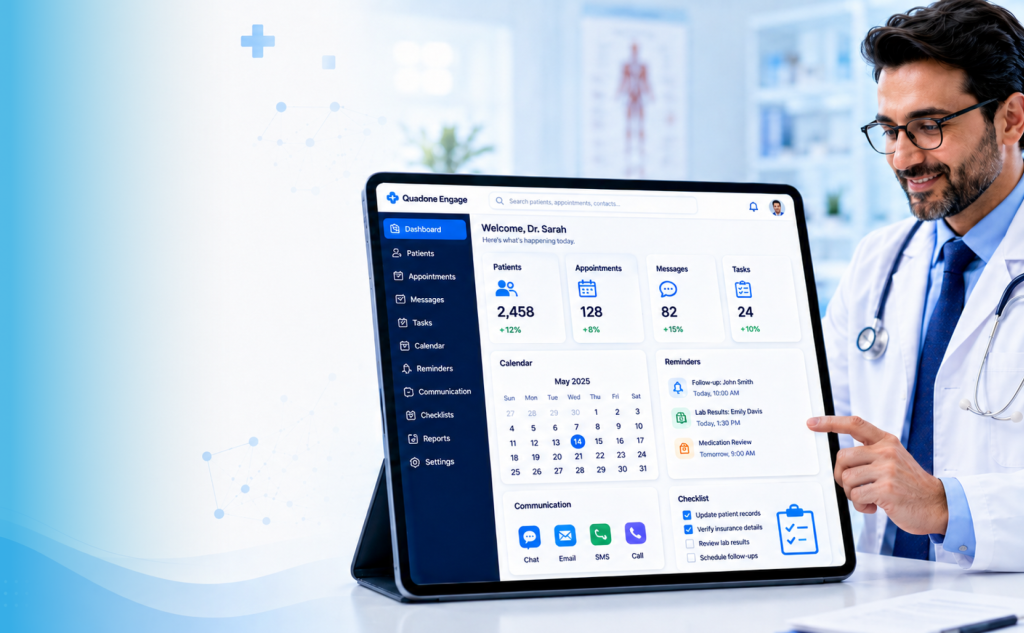
Generating healthcare leads is only the first step. The real impact comes from how quickly and consistently those leads are managed after they come in. QuadEngage healthcare CRM helps healthcare practices streamline lead management, automate follow-ups, and convert more patient inquiries into confirmed appointments.
A patient may submit a form, call a clinic, send a WhatsApp message, attend a webinar, or respond to a campaign. If that inquiry is not captured, assigned, followed up, and tracked properly, the lead can easily be lost.
This is where healthcare CRM and lead management workflows become important. They help teams track every inquiry, assign ownership, automate follow-ups, monitor appointment status, and understand which channels are actually converting.
Healthcare Lead Generation Metrics to Track
| Metric | Why It Matters |
|---|---|
| Total leads generated | Shows inquiry volume |
| Lead source | Shows which channels generate leads |
| Cost per lead | Measures campaign efficiency |
| Response time | Shows how fast teams respond |
| Contact rate | Shows how many leads are reached |
| Lead-to-appointment rate | Shows conversion quality |
| Appointment show rate | Shows whether booked patients attend |
| Follow-up completion rate | Shows process discipline |
| Lost lead reason | Shows why leads are not converting |
| Campaign ROI | Shows business impact |
Conclusion
Healthcare lead generation is ultimately about connecting with the right people at the right time and making their journey easier. It requires more than advertising or sending out emails. Healthcare organizations need to understand their audience, address different stakeholders’ concerns, build trust, stay mindful of compliance, and follow up consistently.
The goal is to bring different lead generation efforts together in a simple and organized way. This can include online content, social media, webinars, referrals, and proper follow-up with potential patients or customers. The focus should not only be on getting more leads, but also on building trust and creating relationships that last.
Turn More Patient Inquiries into Confirmed Appointments
Capture every inquiry, automate follow-ups, and keep patients moving toward their next appointment with QuadEngage healthcare CRM.
Explore QuadoneEngage ➜