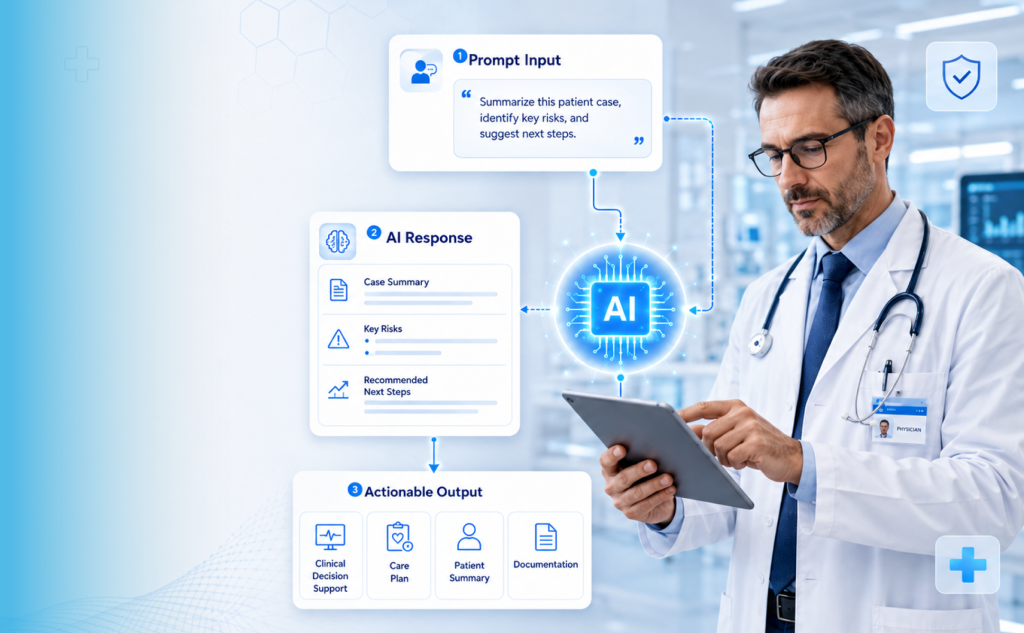
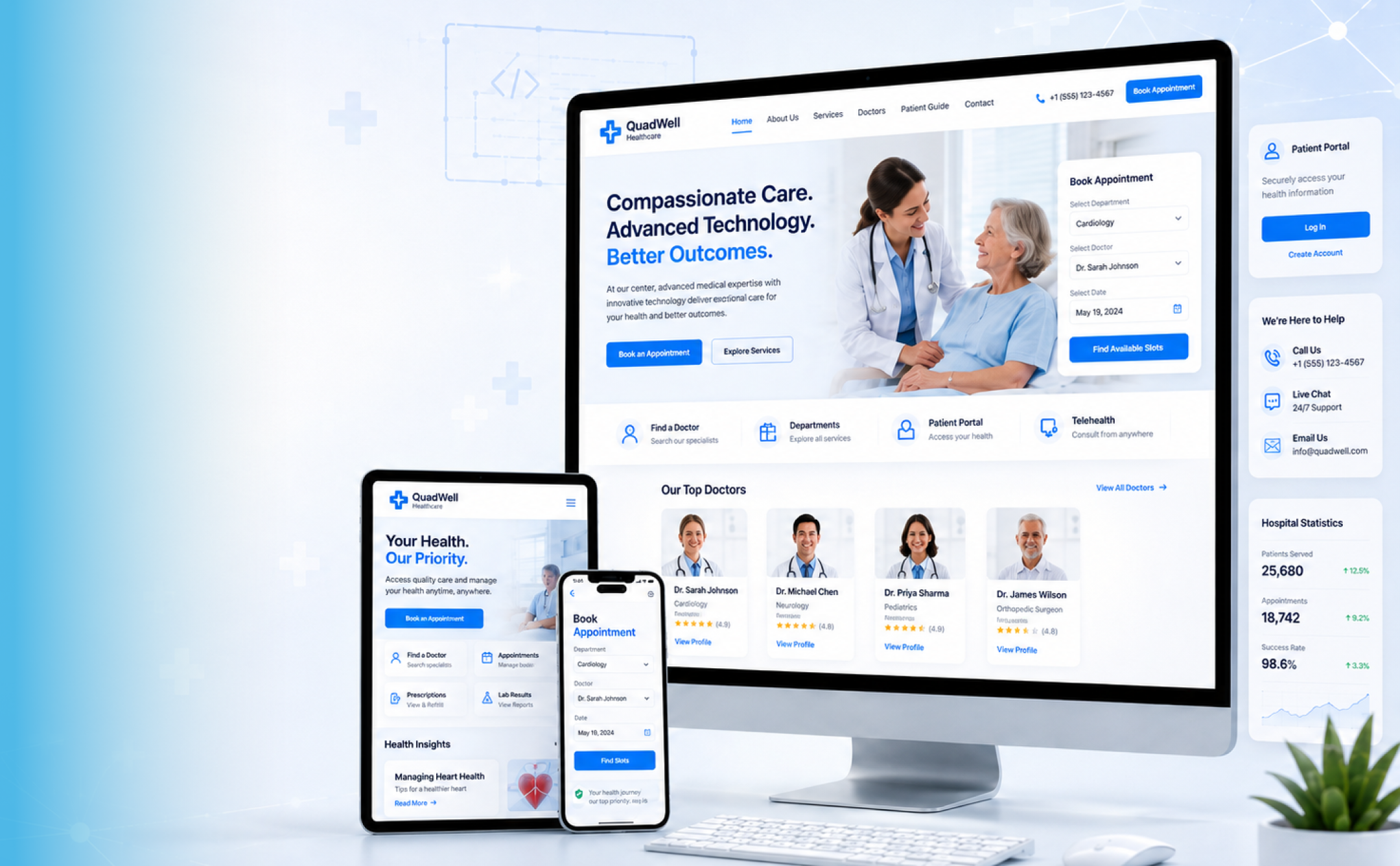
Healthcare providers today are under pressure to deliver care that’s faster, better, and more accessible, and that shift starts with how their digital systems are built. From hospital websites to full-scale web applications, the goal is the same: stronger patient engagement, smoother operations, and communication that doesn’t break down at the worst moment.
A real healthcare website strategy is more than a digital presence. It’s user-centric design paired with the systems that make care actually work: patient portals, EHR integration, and telemedicine built in from the start. And none of it means anything without HIPAA compliance and solid cybersecurity underneath, protecting patient data and earning the trust that makes people willing to use these tools in the first place.
Key Points:
- Healthcare Web Development enables providers to create digital platforms that improve patient access, engagement, and operational efficiency.
- A strong approach to healthcare website development, combined with effective design, enhances trust, visibility, and user experience.
- Modern platforms integrate essential solutions such as patient portal development, telemedicine capabilities, and CRM systems to build a connected ecosystem.
- Features such as real-time appointment booking and patient portals improve convenience, reduce manual tasks, and streamline communication.
- EHR integration ensures seamless data exchange, reduces duplication, and supports accurate clinical decision-making.
- Ensuring HIPAA compliance along with robust healthcare cybersecurity is critical to protect sensitive patient data and maintain trust.
- A well-developed healthcare web platform helps organizations stay competitive, deliver better care, and build a scalable, future-ready system.
What is Healthcare Web Development?
Healthcare Web Development is the process of designing, building, and maintaining digital platforms primarily for healthcare organizations such as hospitals, clinics, diagnostic centers, and wellness providers.
It involves developing user-friendly websites and web applications that allow patients to access healthcare information easily, book appointments, consult doctors online, view medical records, and receive timely updates. At the same time, it enables healthcare providers to manage operations more efficiently through integrated systems like patient portals, Electronic Medical Records (EMR), and hospital management systems.
Types of Healthcare Websites and Web Applications
Every Healthcare Organization has unique digital needs, with common categories in :
Hospital and Clinic Websites
These are the most common digital touchpoints for healthcare providers. They serve as informational hubs where patients can learn about services, specialties, doctor profiles, and hospital facilities. Modern hospital websites also integrate features like online appointment booking, contact forms, live chatbots, and patient education resources. A well-designed website enhances credibility while making it easier for patients to access care.
Patient Portals
Patient portals are secure, login-based platforms that allow individuals to access their personal health information at any time. Through these portals, patients can view medical records, lab test results, prescriptions, and visit summaries. They also enable communication with healthcare providers, appointment scheduling, and bill payments, improving transparency and patient engagement.
Telemedicine Platforms
Telemedicine platforms facilitate remote healthcare delivery through video consultations. These platforms offer features such as appointment scheduling, real-time video/audio communication, digital prescriptions, and patient record integration. They help healthcare providers extend services beyond physical locations, making care more accessible and convenient.
Healthcare websites increasingly support virtual care journeys, from appointment requests to video consultations. Our guide on telemedicine and e-consultation in healthcare explains how digital access is transforming care delivery.
Healthcare CRM and Engagement Tools
Customer Relationship Management (CRM) systems in healthcare focus on managing patient interactions, improving engagement, and building long-term patient relationships. By capturing patient inquiries through website forms, landing pages, and campaign pages, healthcare CRM software enables hospitals to track patient journeys, assign and manage leads, automate follow-ups, send appointment and check-up reminders, and execute targeted outreach campaigns. These capabilities help healthcare teams monitor inquiry-to-appointment conversions, enhance patient retention, and deliver a more personalized and efficient patient experience.
E-Pharmacy and Online Ordering Platforms
E-pharmacy platforms enable patients to order medicines online and have them delivered to their doorstep. These systems often include features like prescription uploads, automated refill reminders, order tracking, and payment integration. They simplify medication management and improve adherence to treatment plans.
Health and Wellness Apps
These applications are designed to promote preventive care and healthy living. They include features such as fitness tracking, diet monitoring, mental wellness support, and chronic disease management tools. By encouraging users to take proactive steps toward their health, these apps contribute to overall well-being.
Provider and Admin Dashboards
These are internal systems used by healthcare staff and administrators to manage operations efficiently. They include tools for appointment scheduling, patient management, billing, reporting, and resource allocation. By streamlining workflows and providing real-time insights, these dashboards improve operational efficiency and decision-making.
Healthcare Websites for Real Patient Journeys
Below are examples of healthcare websites developed to support real patient journeys. Each image highlights how different healthcare platforms are designed to improve usability, service discovery, and patient engagement.
A healthcare website must do more than present services online. It should help patients understand specialties, find doctors, explore health packages, book appointments, and take the next step with confidence.
Quad One has supported healthcare digital experiences for organizations such as AINU Hospitals, Apollo ProHealth, and Emirates International Hospital (EIH), where the focus is on building patient-friendly, scalable, and conversion-ready healthcare web platforms.
The following website visuals demonstrate how these platforms are structured to guide users effectively:
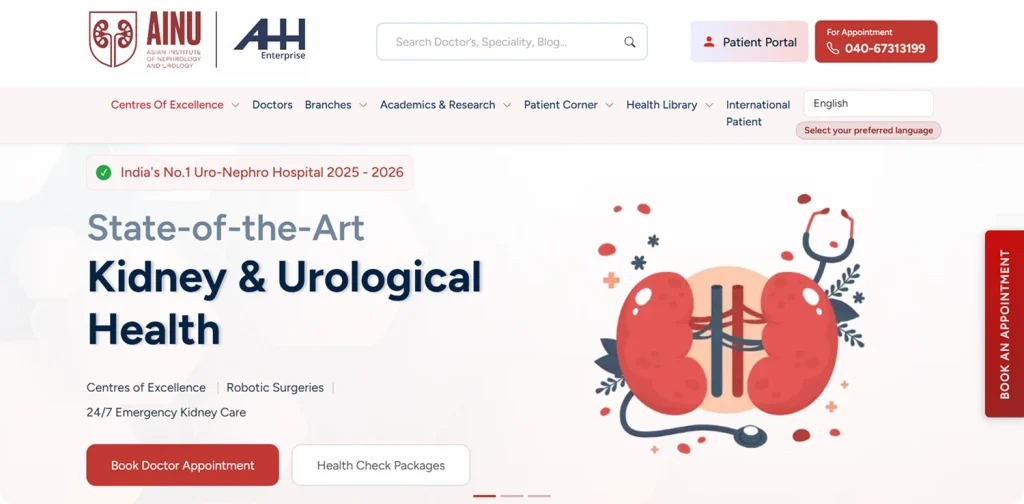
- AINU Hospitals website showcases clear navigation for specialties like urology and nephrology, along with doctor discovery and appointment booking.
Quad One focuses on designing intuitive layouts that help patients quickly identify the right department, understand treatment options, and connect with specialists without confusion. The website structure is built to reduce friction in the patient journey by organizing services, doctor profiles, and locations in a way that feels natural and easy to navigate. Mobile responsiveness and fast-loading pages ensure that patients can access critical healthcare information anytime, especially during urgent situations. SEO-friendly architecture helps the hospital appear in relevant search results, making it easier for patients to discover services when they need them most.
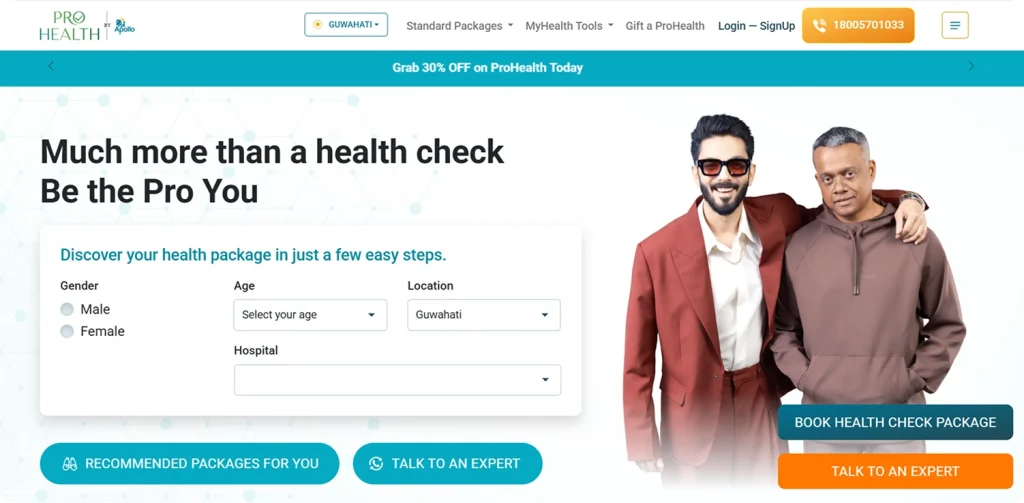
- Apollo ProHealth website highlights preventive healthcare journeys, health checkup packages, and simplified booking flows.
Quad One designs such platforms and healthcare software with a strong focus on clarity, helping users easily compare health packages, understand benefits, and choose the right preventive care plan. The user experience is structured to guide visitors step-by-step, from awareness to decision-making, ensuring higher engagement and conversion rates. Smart content placement, clear CTAs, and streamlined booking processes reduce drop-offs and encourage users to complete their health checkup bookings. Integration-ready design allows seamless connection with CRM systems, payment gateways, and appointment management tools for a smooth backend workflow.
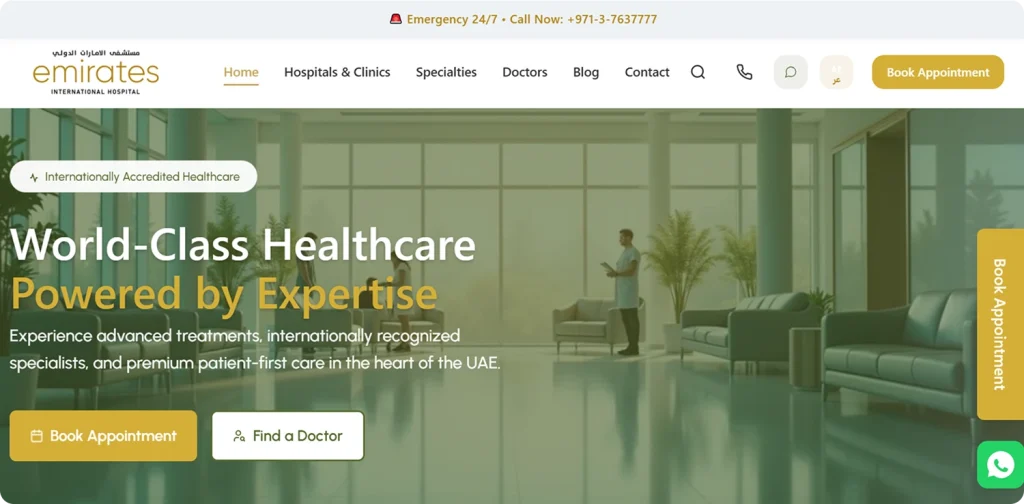
- Emirates International Hospital website demonstrates a comprehensive hospital experience with easy access to specialties, doctor profiles, patient services, and appointment booking.
Quad One builds such hospital websites with a focus on scalability, allowing multiple departments, services, and patient touchpoints to be managed efficiently within a single platform. The design ensures that patients can quickly find relevant information, whether they are exploring treatments, searching for doctors, or looking for hospital facilities. Strong emphasis is placed on trust-building elements such as certifications, patient testimonials, and clear service descriptions to improve credibility. Secure architecture and performance optimization ensure that patient data is protected while maintaining a fast and reliable browsing experience.
Each design focuses on making it easier for patients to explore services, understand offerings, and take action without confusion.
This is where healthcare web development becomes more than a website project. It becomes a patient acquisition, engagement, and service delivery system.
Planning to build or improve your healthcare website?
Quad One can help you create a secure,
mobile friendly, SEO ready, and patient focused healthcare website.
Why Build a Healthcare Web App?
Walk into any clinic waiting room today, and you’ll notice something: half the patients are on their phones, checking symptoms, comparing providers, or trying to figure out why their last bill looked the way it did. Healthcare hasn’t caught up to that behavior as quickly as retail or banking has, and that gap is exactly where a well-built healthcare web app earns its keep. This isn’t about chasing a trend. It’s about meeting patients where they already are and giving care teams tools that actually reduce friction instead of adding another login screen to their day.
The case for healthcare web development gets stronger every year, not weaker. Here’s why providers, hospital groups, and health-tech vendors keep investing in it.
Build trust and credibility with patients.
Healthcare trust is earned in small moments: a clear appointment confirmation, a portal that actually shows the right test results, a billing page that doesn’t feel like a maze. A thoughtfully designed healthcare website signals competence before a patient ever speaks to a clinician. People reasonably assume that an organization careless with its website is careless elsewhere too. The reverse is also true: a clean, fast, well-organized digital front door builds quiet confidence long before the first appointment.
Be present 24/7
Patients don’t only think about their health between 9 and 5. A healthcare web app keeps the lights on around the clock, letting someone book a follow-up at 11 pm, check a prescription refill on a Sunday, or message their care team before a workday starts. Round-the-clock availability isn’t a luxury feature anymore; for many patients, it’s simply the expectation, shaped by every other digital service they use.
Compete in the marketplace.
Healthcare has quietly become a competitive market in most regions, and patients increasingly choose providers the way they choose anything else online by comparing options, reading reviews, and judging the digital experience before they ever walk in the door. A dated or clunky web presence doesn’t just look unpolished; it actively pushes prospective patients toward a competitor whose app simply feels easier to use.
Improve online visibility and discoverability.
A strong healthcare website development strategy isn’t only about what happens after a patient lands on the site; it’s also about helping them find it in the first place. Structured content, fast load times, and mobile-first healthcare website design all feed into how visible a provider is in search results, which matters enormously when someone is searching for care close to home, often in a moment of real urgency.
Optimize workflows and patient communication.
The least glamorous benefit is often the most valuable one: a good web app quietly removes manual work from front-desk and clinical staff. Appointment reminders that send themselves, intake forms that populate the right fields, secure messaging that doesn’t require a phone tag- these aren’t flashy features, but they free up staff time and reduce the small errors that come from juggling too many disconnected systems.
How to Develop a Healthcare Web App?
Healthcare web development carries more weight than a typical consumer app project, mostly because the cost of getting it wrong a compliance gap, a confusing booking flow, a security lapse is so much higher. A disciplined, staged approach keeps that risk manageable.
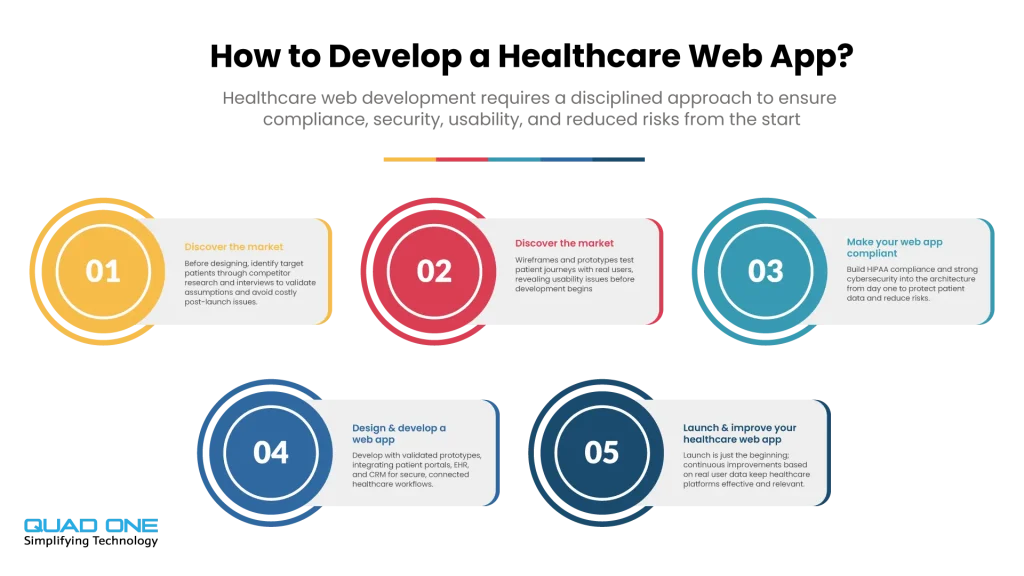
Discover the market
Before a single screen gets designed, it’s worth understanding who the app is really for: which patients. Competitor research and patient interviews at this stage save far more time than they cost, because they surface assumptions that would otherwise only get caught after launch.
Design & test a prototype
Wireframes and clickable prototypes let a team test the patient journey searching for a doctor, completing a doctor appointment booking flow, viewing a result before any code is written. Testing with real patients and real clinicians at this stage, even informally, tends to reveal usability issues that a design team alone would miss.
Make your web app compliant.
This is the step that separates serious healthcare platforms from everything else. HIPAA compliance has to be built into the architecture from day one: encrypted data at rest and in transit, strict access controls, detailed audit logs, and signed business associate agreements with every vendor that touches patient data. Bolting compliance on after launch is far costlier and far riskier than designing for it from the start. Alongside the regulatory checklist, healthcare cybersecurity needs equal attention: regular penetration testing, intrusion detection, and a clear incident response plan, because healthcare data remains one of the most targeted categories for breaches anywhere online.
Design & develop a web app
With a validated prototype and a compliance framework in place, development can move with confidence. This is also where integrations get built: patient portal development for secure record access, EHR integration so clinical data flows without duplicate entry, and CRM integration so marketing, scheduling, and care coordination teams are all working from the same patient view rather than five disconnected spreadsheets.
Launch & improve your healthcare web app.
Launch is a starting line, not a finish line. Real usage data where patients drop off, which features go unused, and where support tickets cluster tells a far more honest story than any pre-launch assumption did. The healthcare platforms that stay relevant are the ones that treat the months after launch as continuous, evidence-based refinement rather than a one-time project to check off.
Is Your Healthcare Website Helping Patients Take Action?
Many healthcare websites look good but still lose potential patients because the journey is unclear. Patients may struggle to find the right service, compare doctors, understand packages, book appointments, or contact the care team quickly.
A healthcare website audit helps identify these gaps before they affect patient acquisition and conversions.
At Quad One, we review your healthcare website across key areas such as page structure, mobile experience, appointment flow, content clarity, SEO readiness, loading speed, trust signals, and CTA placement.
Whether you run a hospital website, specialty care platform, preventive health portal, or healthcare service website, the goal is simple: make it easier for patients to find what they need and take the next step.
Get a free healthcare website audit from Quad One.
We’ll help you understand what is working, what is missing, and where your website can convert better.
Request a Free Audit ➜Core Features That Power a Future-Ready Healthcare Web Platform
A future-ready healthcare web platform is more than just a website. It’s a connected digital ecosystem designed to improve patient care and streamline healthcare operations. By combining essential features like patient portals, appointment scheduling, telemedicine, secure data management, and seamless integrations, healthcare organizations can deliver better patient experiences while improving efficiency, security, and long-term scalability.
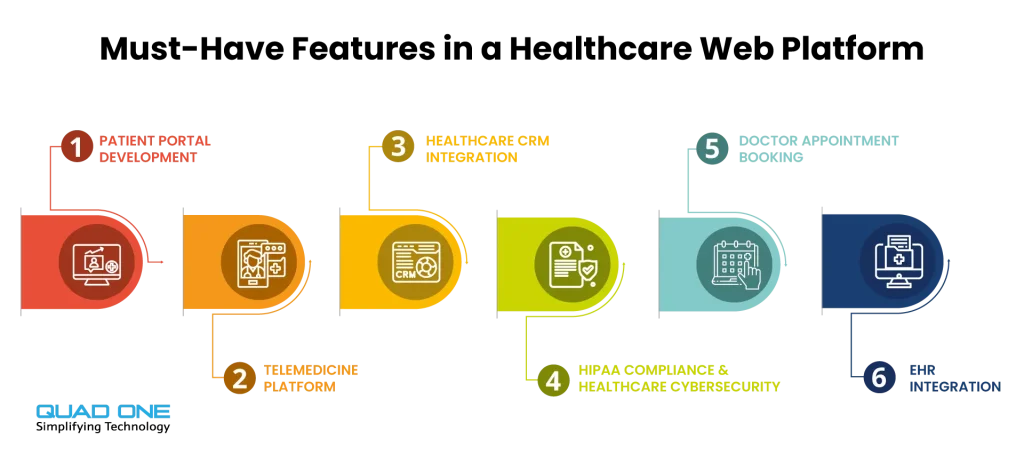
Patient Portal Development
- Provides a secure, centralized place for patients to access records, lab results, prescriptions, and doctor notes
- Enables direct communication with care teams without long wait times
- Reduces dependency on manual processes like calls and paperwork
- Empowers patients with transparency and control over their own health information
Doctor Appointment Booking
- Real-time scheduling based on actual provider availability
- Simple and quick booking experience for patients
- Automated reminders to reduce missed appointments
- Minimizes no-shows and improves overall clinic efficiency
EHR Integration
- Bidirectional data synchronization across systems
- Eliminates duplicate data entry and reduces errors
- Ensures clinicians always access up-to-date patient information
- Frees up time for patient care instead of administrative tasks
Telemedicine Platform
- Integrated video consultations within the same platform (no separate apps needed)
- Seamless user experience with a single login
- Low-latency, high-quality communication for effective virtual care
- Improves access for remote patients and those with chronic conditions
Healthcare CRM Integration
- Connects patient relationship data with scheduling and outreach systems
- Enables automated follow-ups and engagement tracking
- Helps identify and re-engage patients who may fall out of care
- Strengthens continuity and quality of patient relationships
HIPAA Compliance & Healthcare Cybersecurity
- Built-in data encryption, access controls, and audit trails
- Continuous monitoring and threat detection
- Ensures patient data privacy and system reliability
- Establishes trust by making security a foundational element, not an afterthought
For AI-enabled healthcare platforms, data privacy and governance should also align with healthcare AI compliance and regulatory updates to ensure responsible and secure digital adoption.
Conclusion:
Healthcare web development is no longer a nice-to-have; it has become the backbone of modern healthcare delivery. It influences how patients build trust before their first visit, how efficiently care teams operate, and how securely sensitive data is handled in an increasingly targeted industry. Key capabilities such as patient portals, real-time appointment booking, EHR integration, telemedicine platforms, CRM connectivity, and HIPAA compliance are not standalone features, but interconnected parts of a system that must continuously deliver value.
The providers who succeed will not simply focus on adding more features, but on building with patients and compliance at the core from the very beginning. By prioritizing healthcare cybersecurity and continuously improving based on real user behavior, healthcare web platforms can evolve beyond a technical solution into a seamless, reliable, and patient-centered way of delivering care.
Build a Healthcare Website That Works for Patients
Your healthcare website is often the first interaction a patient has with your organization. If it is slow, confusing, outdated, or difficult to navigate, patients may leave before booking an appointment or exploring your services.
Quad One helps hospitals, clinics, wellness brands, and healthcare organizations build websites and web applications that are designed around patient experience, performance, SEO, security, and conversions.
From hospital websites and specialty care platforms to preventive health journeys, appointment booking systems, patient portals, healthcare CRM workflows, and custom healthcare web applications, we help healthcare brands create digital platforms that are easier to use and easier to manage.
If you are planning a new healthcare website or want to improve an existing one, Quad One can help you build a stronger digital experience.
Create a secure, patient focused, and scalable healthcare website that builds trust, increases appointments, and supports your long-term digital success.
Contact Our Experts ➜