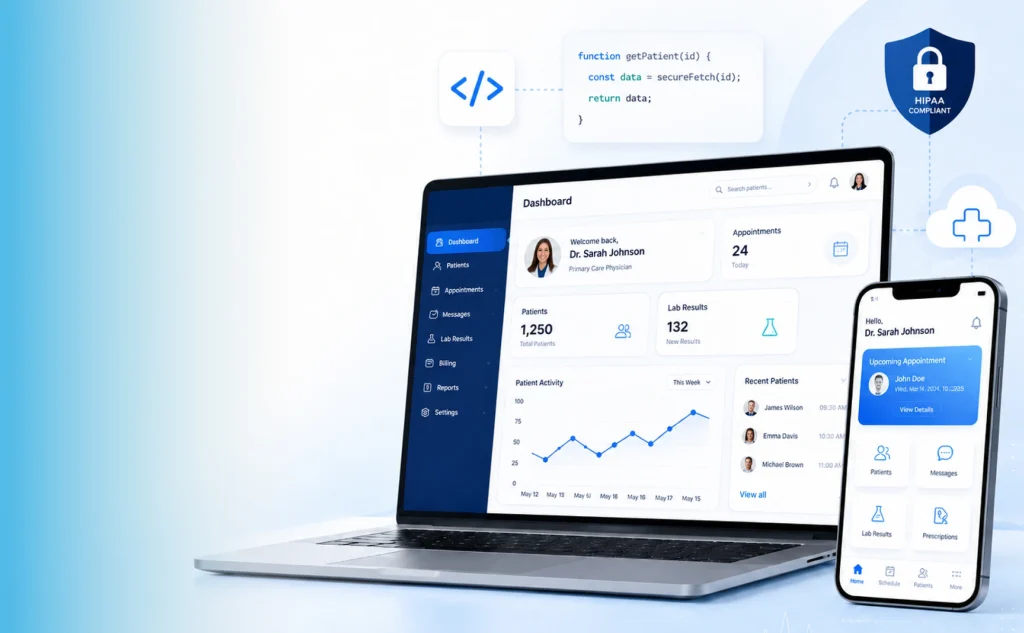
Finding the right healthcare software is becoming increasingly important for hospitals and healthcare providers. Delayed responses, disconnected systems, and time-consuming processes are still common challenges. As India’s healthcare sector grows rapidly, the need for reliable technology solutions that solve these everyday problems is greater than ever.
Technology can make a real difference in how healthcare providers manage their operations and interact with patients. From handling appointments and patient records to automating workflows and improving communication, the right software can simplify daily tasks and create better patient experiences. This presents an opportunity for healthcare IT companies to develop practical, scalable, and AI-driven solutions that help providers work more efficiently and focus on delivering quality care.
Key takeaways:
- Improve healthcare workflows: Digital solutions help simplify appointments, patient communication, billing, and daily hospital operations.
- Choose the right technology partner: Healthcare experience and an understanding of clinical and administrative workflows are essential.
- Connect existing systems: Integrating EHR, HIS, CRM, billing, and laboratory systems helps improve data flow and coordination.
- Prioritize security: Data protection and applicable compliance requirements should be considered from the beginning.
- Plan for long-term growth: Ongoing maintenance, system upgrades, and scalable solutions help healthcare organizations adapt to changing needs.
Why Healthcare IT Services Matter for Indian Healthcare Providers
Healthcare is becoming increasingly digital, with patients expecting faster services, easier access to medical records, and better communication with providers. Healthcare IT services help hospitals and other healthcare organizations meet these expectations by improving daily operations, managing patient data, and supporting better decision-making. From hospital management systems and electronic health records to telemedicine and AI-powered tools, the right technology helps Indian healthcare providers improve efficiency, reduce manual work, and deliver better patient care.
There are several components that contribute to better healthcare delivery, from simplifying appointment booking to protecting sensitive patient information. This is why many healthcare providers are investing in digital solutions and working with healthcare IT services companies in India to address their operational challenges. These companies offer a range of services, including healthcare software development, system integration, workflow automation, and patient engagement solutions, helping providers build more connected and efficient healthcare systems.
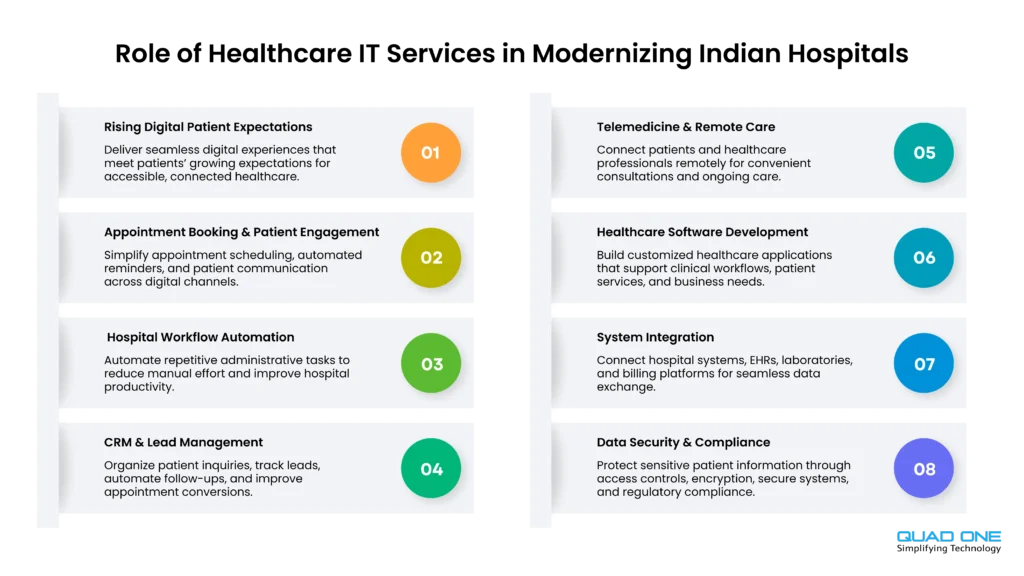
Rising digital patient expectations
As the world becomes more digital, patient expectations are changing. Patients want healthcare services to be simple, quick, and convenient, from booking appointments and accessing medical reports to consulting doctors online. They also expect timely updates, easy communication, and less waiting time. Healthcare IT services help hospitals and clinics meet these expectations through online appointment systems, patient portals, telemedicine, and automated communication tools. By making healthcare services easier to access and manage, providers can improve the overall patient experience and build stronger relationships with their patients.
Appointment booking and patient engagement
It all starts with appointment booking, the first step toward moving away from traditional queues and manual scheduling. Digital booking systems help patients schedule visits at their convenience, while automated reminders, follow-ups, and timely communication keep them informed and engaged throughout their healthcare journey.
Hospital workflow automation
Hospitals handle multiple tasks every day, and managing everything manually can slow down operations and increase the chances of errors. Hospital workflow automation streamlines routine processes, reduces administrative workload, and improves coordination between departments, allowing healthcare teams to work faster and deliver better patient care.
CRM and lead management
When an inquiry does not result in the desired outcome, the problem may not be the initial interaction. Sometimes, a missed follow-up or a delayed response can make all the difference. CRM and lead management help healthcare teams stay connected with patients, track inquiries, and ensure that every patient gets the attention they need.
Telemedicine and remote care
Care is non-negotiable, whether it’s in person or online. Doctors strive to provide the same attention and support, even when they cannot meet face-to-face. Telemedicine and remote care make it easier for patients to consult doctors, receive medical guidance, and stay connected with healthcare providers from the comfort of their homes.
Healthcare software development
Healthcare software is designed to help clinics, hospitals, and other healthcare providers manage their daily operations more efficiently. From maintaining patient records and scheduling appointments to simplifying workflows and connecting different systems, it helps healthcare teams spend less time on administrative tasks and more time focusing on patient care. This is where healthcare software companies in India play an important role by developing solutions tailored to the needs of healthcare organizations.
System integration
When healthcare organizations use separate systems that do not communicate with each other, managing daily operations can become time-consuming and complicated. System integration connects these tools, allowing information to flow between them more efficiently. This reduces repetitive work, minimizes errors, and helps healthcare teams manage their workflows with less effort.
Data security and compliance
When patient information is stored digitally, protecting its privacy and security becomes a priority. Healthcare organizations need appropriate security measures to prevent unauthorized access, data breaches, and misuse of sensitive information. With measures such as data encryption, access controls, and secure storage, healthcare software can help protect patient records while supporting compliance with applicable healthcare regulations.
Together, these capabilities help healthcare providers create a more organized, connected, and patient-focused environment. Choosing the right technology partner is an important part of this process. By evaluating the expertise, integration capabilities, security practices, and healthcare experience of healthcare IT companies in India, hospitals and clinics can identify solutions that support their current needs while preparing them for future growth.
Top Healthcare IT Services Companies in India
India’s healthcare IT services companies help hospitals, clinics, and healthcare businesses improve workflows, patient communication, data management, and digital operations. The following companies range from specialized healthcare technology providers to large IT service firms.
1. Quad One Technologies
- Quad One Technologies is a healthcare-focused IT services and product company with around 23 years of experience supporting hospitals, clinics, and healthcare businesses.
- It combines software products, application development, and remote IT management, making it a practical choice for healthcare organizations seeking technology support.
- Its AI-enabled solutions include QuadOne Engage, a healthcare CRM focused on patient engagement, and AI WhatsApp chatbot workflows that automate routine patient communication.
- Its services include custom healthcare software development, healthcare web and app development, hospital system integrations, and ongoing remote IT support.
- Best suited for: Healthcare organizations looking to automate workflows and improve patient communication without a large-scale transformation program.
2. TCS Healthcare
- Tata Consultancy Services (TCS) provides enterprise-scale IT services to healthcare and life sciences organizations.
- Its capabilities include healthcare transformation, data analytics, and technology solutions for payers and providers.
- TCS is particularly suited to large implementation programs involving complex systems, multiple stakeholders, and long-term delivery requirements.
- Best suited for: Large healthcare organizations seeking enterprise technology modernization and large-scale digital transformation.
3. Infosys Healthcare
- Infosys supports healthcare organizations through consulting, digital transformation, and enterprise technology services.
- Its services cover cloud migration, data and analytics, automation, and enterprise systems modernization.
- It helps healthcare businesses modernize legacy platforms and improve the way their technology systems operate.
- Best suited for: Healthcare organizations looking to modernize existing systems and adopt cloud-based, data-driven solutions.
4. HCLTech Healthcare
- HCLTech combines engineering expertise with healthcare technology and IT infrastructure services.
- Its capabilities include healthcare platforms, cloud services, infrastructure management, and patient experience solutions.
- It also supports life sciences organizations with technology engineering and digital solutions.
- Best suited for: Healthcare organizations that need engineering expertise, infrastructure support, and application development.
5. Tech Mahindra Healthcare
- Tech Mahindra combines IT services, connectivity, and digital technologies to support healthcare transformation.
- Its focus areas include connected care, hospital digitalization, artificial intelligence, and automation.
- Its technology capabilities are relevant to healthcare organizations developing remote care services and integrated patient experiences.
- Best suited for: Healthcare providers exploring connected healthcare, remote care, and digital patient engagement.
6. CitiusTech
- CitiusTech specializes in healthcare technology, serving healthcare providers, payers, and life sciences organizations.
- Its core capabilities include healthcare interoperability, data analytics, and digital health solutions.
- It supports projects involving healthcare data exchange, standards, and analytics-driven technology initiatives.
- Best suited for: Healthcare organizations looking for specialized expertise in interoperability, data management, and healthcare analytics.
7. Persistent Systems Healthcare
- Persistent Systems brings a product engineering approach to healthcare technology development.
- Its capabilities span cloud computing, data engineering, digital health, and healthcare software development.
- It helps organizations build, modernize, and scale digital products rather than focusing exclusively on maintaining existing systems.
- Best suited for: Healthcare businesses developing new digital health products or expanding existing software platforms.
8. IKS Health
- IKS Health provides technology-enabled services that help healthcare organizations manage clinical and administrative workflows.
- Its capabilities include healthcare process support, data management, and solutions that help reduce administrative workloads for healthcare providers.
- By combining healthcare expertise with technology, the company helps improve operational efficiency and allows healthcare professionals to focus more on patient care.
- Best suited for : Healthcare providers looking to streamline administrative processes, improve operational efficiency, and adopt technology-enabled healthcare support service.
9. NTT DATA Healthcare
- NTT DATA provides healthcare IT services to hospitals, health systems, public health agencies, and healthcare payer organizations.
- Its capabilities include data and analytics, AI, cloud technology, and digital transformation to help healthcare organizations improve workflows and modernize their systems.
- It supports connected healthcare initiatives that focus on improving collaboration, operational efficiency, and patient experiences.
- Best suited for: Healthcare organizations looking to modernize IT infrastructure, use data more effectively, and develop connected digital healthcare services.
10. Innovaccer
- Innovaccer is a healthcare technology company that helps healthcare organizations bring patient data together from multiple systems.
- Its capabilities include healthcare data management, analytics, AI-powered solutions, and interoperability.
- Its platform helps healthcare teams build a more connected view of patient information, support data-driven decisions, and improve care coordination.
- Best suited for: Healthcare organizations looking to unify patient data, strengthen analytics capabilities, and support coordinated, data-driven care.
Top Healthcare IT Services Companies in India: Quick Comparison
Healthcare organizations have different technology requirements. Some need a partner to develop custom applications, while others need support for large-scale IT modernization, healthcare data integration, or patient communication.
The table below provides a quick comparison of the companies covered in this guide.
| Company | Core Healthcare IT Strengths | Best Suited For |
| Quad One Technologies | Healthcare CRM, AI-powered patient communication, custom applications, system integration | Hospitals and clinics looking for practical, workflow-focused digital solutions |
| TCS | Enterprise IT, healthcare transformation, cloud, AI and analytics | Large healthcare enterprises managing complex technology environments |
| Infosys | Healthcare consulting, EHR services, cloud modernization, data and automation | Healthcare organizations modernizing clinical and administrative systems |
| HCLTech | Healthcare engineering, EHR support, infrastructure, cloud and interoperability | Healthcare providers requiring engineering and enterprise IT support |
| Tech Mahindra | Patient access, healthcare operations, digital engagement, automation and revenue cycle services | Providers and payers improving connected healthcare workflows |
| CitiusTech | Healthcare interoperability, data engineering, analytics and digital engineering | Healthcare organizations with complex data and integration requirements |
| Persistent Systems | Healthcare product engineering, cloud modernization, AI and digital platforms | Healthtech companies and healthcare providers developing or modernizing software |
| IKS Health | healthcare organizations manage clinical and administrative workflows -healthcare process support and data management | streamline administrative processes and adopt technology-enabled healthcare support . |
| NTT DATA Healthcare | healthcare IT services , data and analytics, AI, cloud technology, and digital transformation | modernize IT infrastructure, use data more effectively, and develop connected digital healthcare services. |
| Innovaccer | unifying patient data across systems, healthcare data management, analytics, and AI-powered solutions | strengthen analytics capabilities, and support coordinated, data-driven care. |
The table summarizes each company’s publicly described capabilities and potential project fit. It is not an independent performance ranking.
How to Choose the Right Healthcare IT Services Company in India
Choosing the right healthcare IT services company starts with understanding how well it knows the healthcare workflow. The right partner should understand how hospitals, clinics, and other healthcare organizations operate before recommending or developing technology solutions.
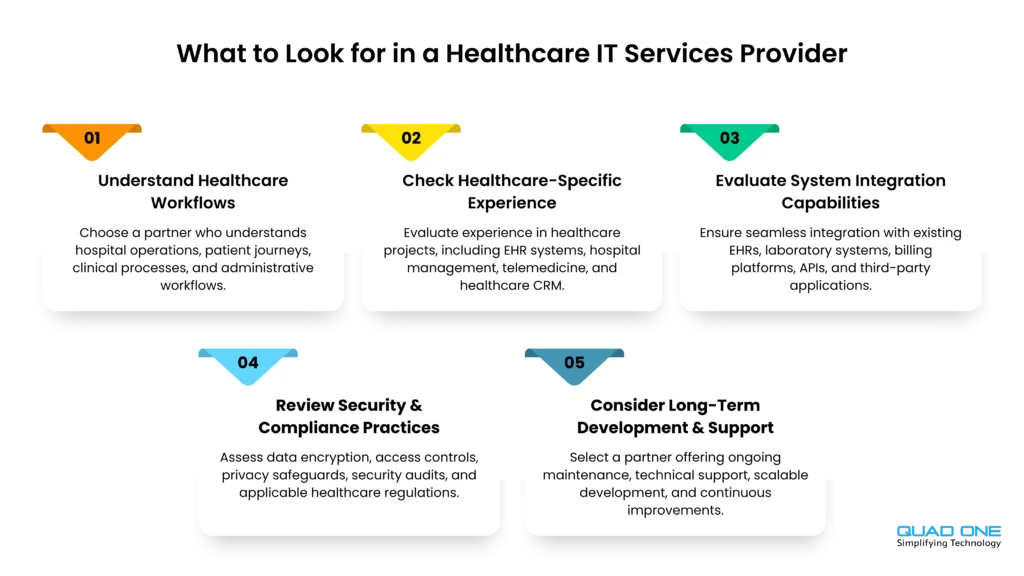
Understand healthcare workflows: Look for a company that understands everyday hospital operations, from patient registration and appointment scheduling to clinical documentation, billing, and follow-ups. This helps ensure that the technology supports existing workflows rather than making them more complicated.
Check healthcare-specific experience: Review the company’s experience working with hospitals, clinics, healthcare networks, or life sciences organizations. Case studies and previous projects can help you assess whether it has solved challenges similar to yours.
Evaluate system integration capabilities: Healthcare technology involves multiple systems, including Electronic Health Records (EHR), Hospital Information Systems (HIS), Customer Relationship Management (CRM), billing, laboratory systems, and patient engagement platforms. Choose a partner that can integrate these systems to support consistent data exchange and coordinated workflows.
Review security and compliance practices: Healthcare systems handle sensitive patient information, so data protection should be a priority. Assess encryption, access controls, audit logs, backup processes, and relevant regulatory requirements, such as India’s applicable data protection rules or HIPAA for US healthcare operations.
Consider long-term development and support: Healthcare technology needs change as organizations grow, add facilities, or introduce new services. Choose a company that can provide ongoing maintenance, system upgrades, new integrations, and scalable development, along with reliable technical support after implementation.
Why QuadOne Is a Strong Healthcare IT Partner
Quad One Technologies is a suitable choice for healthcare organizations looking for practical, workflow-driven technology solutions. Its offerings span patient engagement, AI-powered communication, healthcare CRM, custom software development, web platforms, system integration, and remote IT management.
For hospitals and clinics, this means having a technology partner that can support both patient-facing services and internal operations, from managing inquiries and appointments to coordinating follow-ups, running digital campaigns, and connecting systems to improve day-to-day efficiency.
Conclusion
Choosing the right healthcare IT services company is about finding a partner that understands how healthcare organizations work and can turn their challenges into practical technology solutions. The right combination of software development, system integration, automation, and patient engagement can help improve operational efficiency and the patient experience.
Quad One Technologies is worth considering for healthcare organizations seeking workflow-driven solutions across healthcare CRM, AI-powered communication, custom software development, system integration, and remote IT management. Its focus on both patient-facing services and internal operations makes it a relevant option for organizations looking to strengthen their digital capabilities.